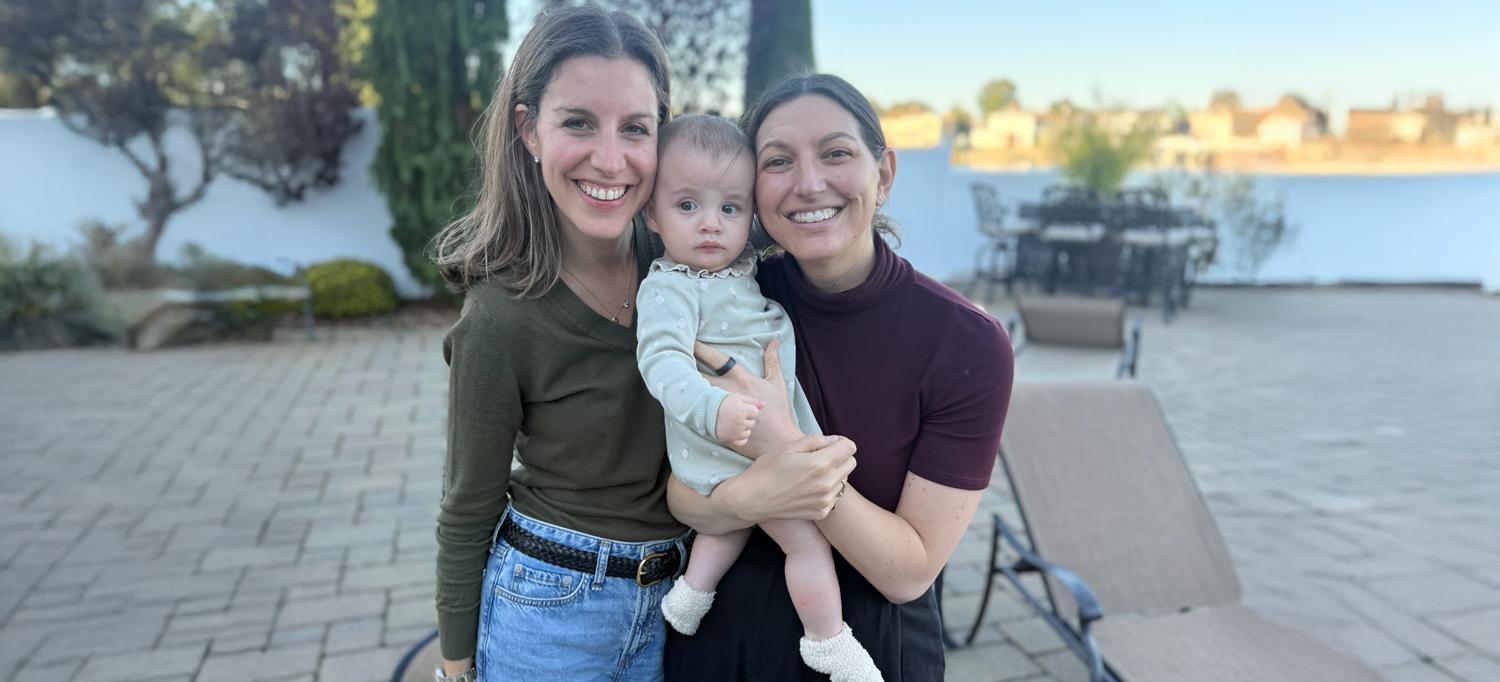
“I’m so grateful to this incredible team for giving me back my life,” says Elyssa Byck (right), with her wife, Jillian, and their daughter, Maisie.
Courtesy of Elyssa Byck
In August 2023, Elyssa Byck, then 35, had a mammogram prior to pursuing in vitro fertilization (IVF) at a private clinic. The test showed nothing abnormal in her breasts, but detected a swollen lymph node in her right armpit. A follow-up biopsy revealed a potentially serious problem, but it wasn’t cancer.
The pathology report arrived while Byck and her wife, Jillian, were in Italy. It indicated a probable diagnosis of sarcoidosis, a rare inflammatory disease in which clumps of immune cells called granulomas proliferate in the lungs, skin, and lymph nodes, among other organs. “I’d never heard of it,” says Byck, a media executive who works out daily with a personal trainer and who felt perfectly healthy. “I thought the results could be a false alarm, but the condition sounded scary. I wanted to get checked out as soon as I got home.”
Although mild cases of sarcoidosis may cause no symptoms, the lesions can interfere with normal functions throughout the body, with debilitating and sometimes life-threatening impacts. In most of the approximately 27,000 cases diagnosed annually in the United States, the underlying cause remains unknown.
Back in the States, Byck consulted rheumatologist Natalie Azar, MD, whom she’d previously seen about an unrelated condition. “I’d read that the Sarcoidosis Program at NYU Langone was the best,” she says. That reputation rests, in part, on NYU Langone’s No. 1 national ranking in cardiology, heart surgery, vascular surgery, and pulmonology and lung surgery, according to U.S. News & World Report. The Sarcoidosis Program takes an uncommonly comprehensive approach to this complex disorder. “Multidisciplinary coordination is crucial,” explains dermatologist Avrom S. Caplan, MD, the program’s co-director. “We bring together specialists in every organ for each patient who enters our care.”
Imaging tests ordered by Dr. Azar showed that granulomas were also present in Byck’s lungs, so she referred her patient to pulmonologist Nathaniel C. Nelson, MD. Because Byck had none of the classic symptoms of pulmonary or cardiac sarcoidosis—shortness of breath, cough, chest pain, irregular heartbeat, and fatigue—Dr. Nelson thought her case might be mild. Still, he spent an hour making sure he didn’t miss any hidden danger signs. “Dr. Nelson went above and beyond in every way,” Byck recalls. The final test, an electrocardiogram, brought an unwelcome surprise: Byck had a delay in signals from the upper chambers of the heart to the lower chambers. Though the abnormality is minor by itself, it can point to various cardiac problems.
Dr. Nelson referred Byck to another member of the sarcoidosis team, cardiologist Randal Goldberg, MD, associate director of the Heart Transplant Program. Before the appointment, she underwent an echocardiogram and a cardiac MRI. “When I met with Dr. Goldberg,” Byck recalls, “he asked, ‘Are you out of breath when you walk down the street?’ I said, ‘No, doctor, I just did 100 pushups yesterday.’”
Dr. Goldberg’s question stemmed from the imaging, which showed scarring throughout Byck’s heart. As a result, the portion of blood the heart pumps out with each contraction—typically 50 to 70 percent in a healthy person—had fallen to 24 percent. Taken together, the test results pointed to severe cardiac sarcoidosis, a condition that can lead to heart failure, dangerously abnormal heart rhythms, and even sudden death. A subsequent scan showed extreme inflammation in the heart. “Elyssa’s continued lack of symptoms may have reflected her superb level of fitness,” says Dr. Goldberg. “But a crash was likely.”
Dr. Goldberg devised a multipronged treatment approach. He prescribed a high-dose steroid to tame the inflammation and heart-failure drugs to boost the organ’s pumping power. He also put Byck on the priority list for an implantable cardiac defibrillator, a device that would reset her heartbeat with a zap of current if it grew too rapid and act as a pacemaker if it became too slow. In the meantime, she wore an external defibrillator strapped to her torso 24 hours a day. “That was the first time I was truly terrified,” she says.
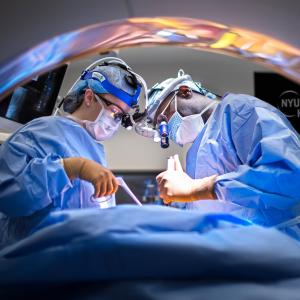
Two weeks later, on October 5, 2023, Byck walked into a surgical suite at Kimmel Pavilion, accompanied by Jillian and by her parents, her two sisters, and her sister-in-law. She was greeted by cardiac electrophysiologist Anthony Aizer, MD, co-director of the Cardiac Sarcoidosis Program. Dr. Aizer made a small incision in her chest and threaded two wires through a vein into her heart: one to monitor heart rhythms, the other to correct them as needed. Then, he implanted a pulse generator the size of a deck of cards beneath her collarbone. Byck went home the same day and, within a week, returned to work remotely during her recuperation.
In December, when a scan showed that the inflammation in Byck’s heart had subsided, Dr. Goldberg began to wean her from the steroid. By February 2024, after another clear scan, Byck and her spouse felt confident enough to resume their plan to start a family. Instead of Byck, it was Jillian who underwent IVF, successfully. The couple’s daughter, Maisie, was born in February 2025.
Today, Byck is back to vigorous daily workouts and feels great. She follows up regularly with her care team to ensure that any potential complications are caught early. Sarcoidosis patients may have an elevated risk of skin cancer, for example, and in August, Dr. Caplan found a dangerous melanoma lesion, which was removed by a dermatologic surgeon.
“We’ll be monitoring Elyssa for decades to come,” notes Dr. Goldberg. “Our goal is to keep her as well as she is right now.”
Meanwhile, Byck is enjoying the adventures of parenthood with Jillian. “I’m so grateful to this incredible team for giving me back my life,” she says. “I look forward to being on this journey with them for a very long time.”