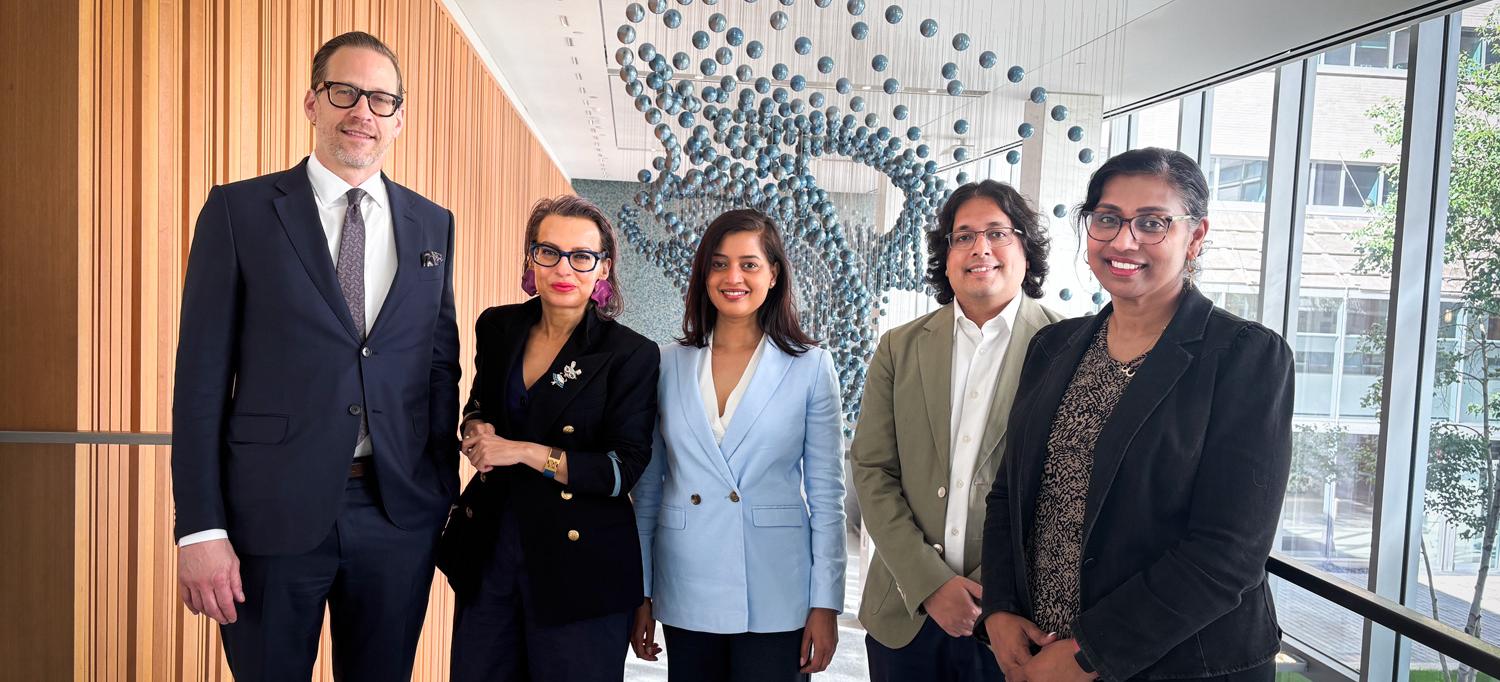
Drs. Paul Gardner, Dimitra Skondra, Shae Datta, Arjun V. Masurkar, and Jinsy A. Andrews discuss the factors that are most essential for brain health.
Credit: NYU Langone
Brain health was once viewed through a narrow lens—focused largely on the brain itself, treated in isolation from the rest of the body. Today, experts understand that protecting the brain means protecting the whole person: The gut, the body, emotional health, and lifestyle all play interconnected roles in how the brain ages, heals, and functions over time.
As conversations about brain health, longevity, and neurological disease surge across social media and the news, so does misinformation. Between viral wellness trends, AI-generated medical advice, and influencer-driven biohacking, it can be difficult for patients to separate evidence-based care from social hype.
To bring clarity, physicians across NYU Langone Health—including experts in concussion and sports neurology, behavioral and cognitive neurology, neurosurgery, ophthalmology, and neuromuscular medicine—came together to break down what supports long-term brain health and what may not.
Their biggest piece of advice: The basics matter most. Sleep, diet, movement, social connection, and mental engagement remain the foundation of lifelong brain health.
Concussion Care Has Evolved—and So Has Recovery
For years, concussion recovery meant retreating into a dark room and avoiding screens. Today, that approach has fallen out of favor.
“Cocooning is out. Nobody should be doing nothing. Maybe for the first 24 hours, then we want you out there,” said Shae Datta, MD, co-director of NYU Langone’s Concussion Center. “Exercise is medicine.”
Physicians emphasized that blood flow is essential to brain recovery, and gentle, low-impact movement—walking around the block, light daily activity—is now the standard of care after the first 24 to 48 hours. Patients are also encouraged to focus on nutrition, since “whatever’s good for the heart is good for the brain.” said Dr. Datta.
Warning signs that warrant medical attention include dizziness, balance issues, pupil changes, and symptoms that don’t resolve within 24 to 48 hours. Concussion can also occur without a direct blow to the head—a hard fall or whiplash injury can cause the brain to move within the skull, producing the same metabolic changes.
Experts also warn about the risks of subconcussive impacts—lighter blows to the head that do not cause immediate concussive symptoms—particularly in youth sports. “Subconcussive hits are equally dangerous because they’re cumulative,” explained Dr. Datta. A child who returns to play too quickly after a concussion and sustains repeated minor jolts may experience longer lasting symptoms weeks later.
Biomarkers Are Changing How We Detect Neurological Disease
One of the most significant shifts in neurology is the rise of biomarkers—measurable indicators in blood, spinal fluid, or urine that can reveal damage or disease activity in the brain.
“We can now diagnose a patient with Alzheimer’s disease with pretty good accuracy,” said Arjun V. Masurkar, MD, PhD, a cognitive and behavioral neurologist at NYU Langone’s Pearl I. Barlow Center for Memory Evaluation and Treatment.
Two Food and Drug Administration–approved blood tests measuring phosphorylated tau (a protein in the brain that can damage brain cells if it builds up excessively) are available, but experts stress that they should be used to direct symptomatic patients toward the right specialist—not to predict disease in healthy individuals.
“These new blood tests shouldn’t be used for prognosticating [the health of] someone who doesn’t have any symptoms,” said Dr. Masurkar.
Biomarkers are likewise transforming care for amyotrophic lateral sclerosis, or ALS. Neurofilament—a marker of nerve damage—has helped advance gene-targeted therapies and is now being used in a presymptomatic study to determine whether treatment can prevent ALS from developing in at-risk patients.
Clinicians can use biomarkers to help measure how neurosurgical approaches affect the brain, while the shed of tumor DNA into the bloodstream may eventually allow clinicians to detect tumor recurrence with a simple blood test.
In ophthalmology, advanced imaging can detect retinal disease at the micrometer level, and emerging stool-based biomarkers are helping predict who will progress to blindness from macular degeneration—the leading cause of blindness in people over 50.
Patient Concerns in the Age of Information
Patients today arrive at clinics with more information—and more misinformation—than ever before. AI tools, social media influencers, and unregulated wellness clinics have reshaped how people understand their health.
“ChatGPT hallucinates pretty frequently. So when people come in now, I have to contend with printouts from ChatGPT,” said Jinsy A. Andrews, MD, a neuromuscular specialist and the director of the NYU Langone ALS Center. “For someone who’s not in that space, it’s very difficult to tell what’s true and what’s not.”
Physicians regularly see patients who are convinced they have a serious neurological disease based on a single symptom and an internet search. “Someone has been experiencing twitching, and they just had a Covid infection—their neurofilament is going to be high, but they don’t have ALS,” said Dr. Andrews. “It takes a specialist to tease that out.”
Even seemingly healthy habits can be taken too far. One patient came in with concerning muscle twitching after drinking seven Liquid I.V. electrolyte supplements a day; another developed atrial fibrillation after taking a high-caffeine preworkout supplement he learned about on TikTok.
“There’s always too much of a good thing,” said Dr. Datta. “Overexercising, especially with women, can stop their cycles and lead to osteopenia and osteoporosis. We’re in a society of extremes.”
Experts also warn about unregulated stem cell clinics, hyperbaric oxygen therapy treatments for unproven uses, and “fever therapy” for ALS reversal—which have sometimes resulted in patient deaths. Promising therapies like psilocybin, currently being studied for depression and brain injury, must be used under medical supervision and within research protocols.
The Gut-Brain Connection—and the GLP-1 Question
Perhaps the most unifying theme across every neurological specialty is the growing recognition that the gut and the brain are deeply connected.
“It’s very natural to want to study the interaction between the gut and the brain to get a better handle on Alzheimer’s treatment and diagnosis,” said Dr. Masurkar. National studies are examining how the gut microbiome shifts in patients at risk for Alzheimer’s.
Early research suggests that fecal transplants and probiotics may help slow the progression of ALS by reducing systemic inflammation. In neurosurgery, the gut microbiome appears to influence everything from vascular malformations to how patients respond to immunotherapy for tumors. In ophthalmology, diet and gut health have been shown to influence the progression of macular degeneration.
“Fiber is key,” said Dimitra Skondra, MD, PhD, a vitreoretinal ophthalmologist and vice chair of research for the Department of Ophthalmology at NYU Grossman School of Medicine. “Ninety percent of Americans don’t get enough fiber, and fiber is what the microbes need to make short-chain fatty acids—these miracle molecules.”
The conversation around the gut-brain axis has raised important questions about GLP-1 medications. While these drugs have transformed weight management and metabolic health, experts urge caution about their widespread off-label use.
“Messing with the hypothalamus is one thing we try to never, ever do,” said Paul A. Gardner, MD, a neurosurgeon and the director of the NYU Langone Skull Base Surgery Center. “So messing with it chemically makes me very nervous. Your hypothalamus tells your pituitary what to do. Your pituitary tells every hormone in your body what to do.”
For patients with symptoms of ALS, early observations suggest that GLP-1 use may be associated with faster progression, and researchers are actively investigating whether rapid weight loss could trigger the disease in vulnerable populations. As for retinal disease, retrospective ophthalmological studies have produced conflicting findings about the effects of GLP-1s.
“The entry level for GLPs in medicine is endocrinology—physicians who know hormones and know what they’re supposed to be tracking,” said Dr. Datta. “There’s a method to the madness.”
Media Inquiries
NYU Langone Media Relations
News@NYULangone.org