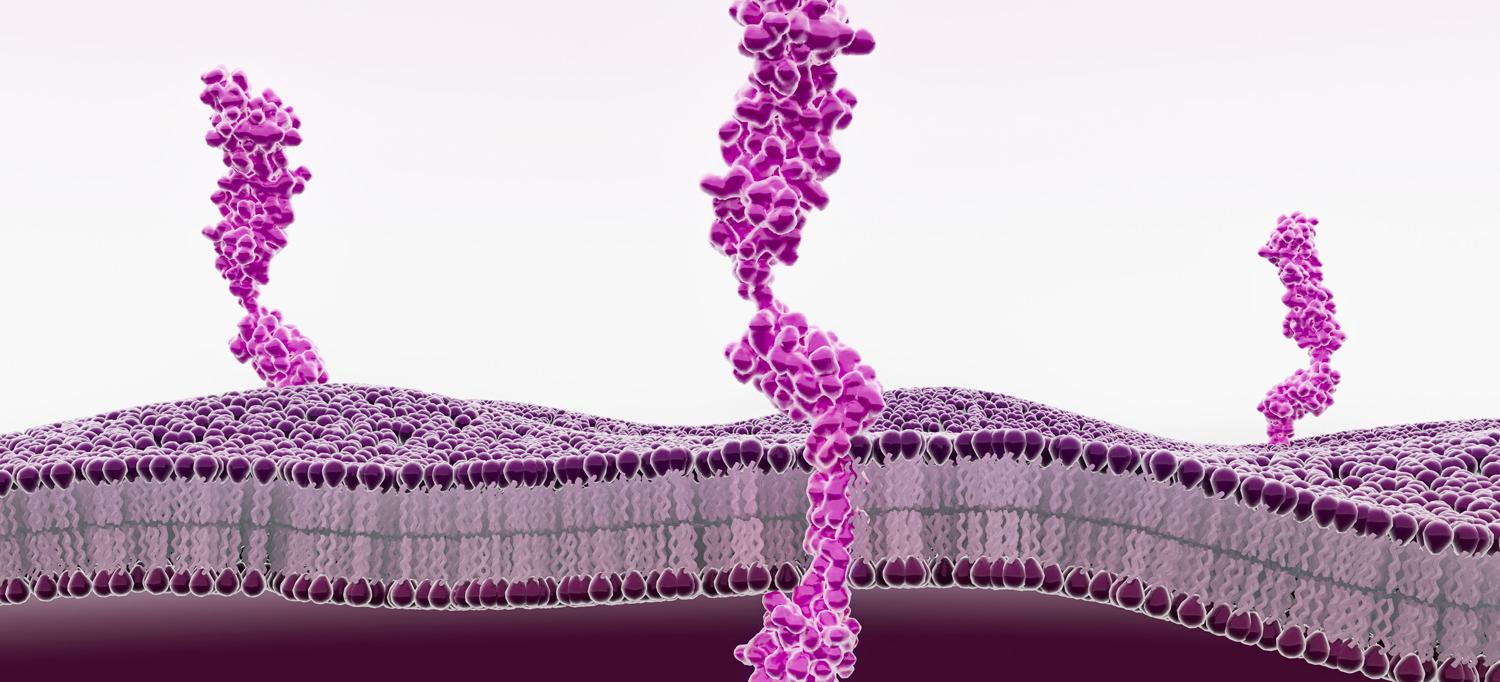
Illustration of a receptor for advanced glycation end products, or RAGE, within a lipid bilayer membrane. RAGE contributes to an inflammatory process that can trigger diabetes complications, including heart disease, kidney disease, and poor wound healing.
Credit: Getty Images / Thom Leach / Science Photo Library
In type 1 and type 2 diabetes, a surprising number of complications— including heart disease, kidney disease, and poor wound healing—can compound the danger for patients. Research has suggested that these threats arise from an inflammatory process that hinges on a protein called the receptor for advanced glycation end products, or RAGE.
A new study by NYU Langone Health researchers has identified a therapeutic drug candidate that might help quell diabetic complications. Published as the cover story in the journal Cell Chemical Biology, the study suggests that the experimental drug binds to RAGE, blocking its ability to link up with its molecular collaborator—called diaphanous-related formin 1, or DIAPH1—and trigger the destructive pathway. In essence, the potential drug jams a lock to keep the harmful key from being inserted.
The study’s senior co-author, Ann Marie Schmidt, MD, the Dr. Iven Young Professor of Endocrinology in the Department of Medicine at NYU Grossman School of Medicine, notes that diabetes can permanently increase the risk of other health issues. “Simply lowering the blood glucose levels with insulin or oral agents doesn’t erase the complications,” she says. “High glucose exposure, even years earlier, can change the signature of the body’s cells.”
In people with diabetes-related injuries (such as foot ulcers), immune cells that respond to the danger can become altered through molecular signals and cause chronic inflammation in tissue throughout the body. The phenomenon is why diabetes is associated with a higher risk of head-to-toe problems, including stroke, blindness, heart disease, kidney disease, and impaired wound healing, as well as nerve damage and poor circulation, sometimes leading to amputations of the lower extremities. The best way to prevent these complications may be to block the mechanism that causes the inflammation in the first place. A few decades ago, Dr. Schmidt and other researchers began identifying potential ways to block that mechanism, focusing on molecules that interact with RAGE.
Studies in mice suggest that the RAGE pathway evolved in mammals as an energy-hoarding strategy that enabled them to survive periods of extreme cold or limited food availability. In someone with diabetes, however, the lack of sugar-processing insulin leads to excess glucose levels in the blood and a buildup of the signaling molecules that can keep the RAGE pathway active. Thus, the “survival mode” pathway can get stuck in the on position, preventing the body from spending the energy it needs to maintain critical processes.
While searching for protein partners that bind to RAGE and encourage its destructive effects, Dr. Schmidt previously discovered that the DIAPH1 molecule, which binds to the tail end of RAGE, is essential in triggering the pathway. Her lab showed that in diabetic mice, knocking out the DIAPH1 gene worked just as well in protecting the animals from complications as did eliminating the RAGE gene itself.
Dr. Schmidt and other researchers wondered whether a molecule that blocked the DIAPH1-RAGE interaction might offer comparable protection. An early drug candidate, discovered through a screen of more than 58,000 compounds, was found to contain a structure that can alter the sequence of DNA—an unwanted side effect that may elevate cancer risk. So the Schmidt Lab, in collaboration with medicinal chemist Robert DeVita, PhD, modified the compound to remove the portion responsible for its mutation-causing potential. The result was a small molecule called RAGE406R that blocked the RAGE pathway as well as, if not better than, its predecessor, but without the possibility of harmful side effects.
In their study, Dr. Schmidt and her team showed that the new therapeutic drug candidate dampened the inflammation that often accompanies diabetes. In addition, when administered topically to diabetic mice, the compound sped up wound healing. When the researchers incubated the RAGE406R compound with blood cells from human patients with type 1 diabetes, they saw another encouraging sign: The molecule significantly tamped down the activity of a protein linked to the inflammatory response within diabetic tissue.
The Schmidt Lab is working with the startup DiaphOne Therapeutics to complete the preclinical investigations for a phase 1 clinical trial in human patients. The preclinical tests may include gauging the effect of the drug candidate on organoids, miniature three-dimensional stand-ins for human organs that are grown from stem cells.
Early lab tests in mice suggest that RAGE406R can similarly reduce complications of diabetic kidney disease and amyotrophic lateral sclerosis, a progressive neurodegenerative disease also known as Lou Gehrig’s disease.
“We’re working under the premise that the RAGE pathway is not unique to diabetes but is associated with a host of other diseases, including Alzheimer’s,” says Dr. Schmidt. If the drug candidate proves itself, she adds, “it might one day fill an important treatment gap by becoming part of a combination therapy that targets both the underlying disease and its complications.”