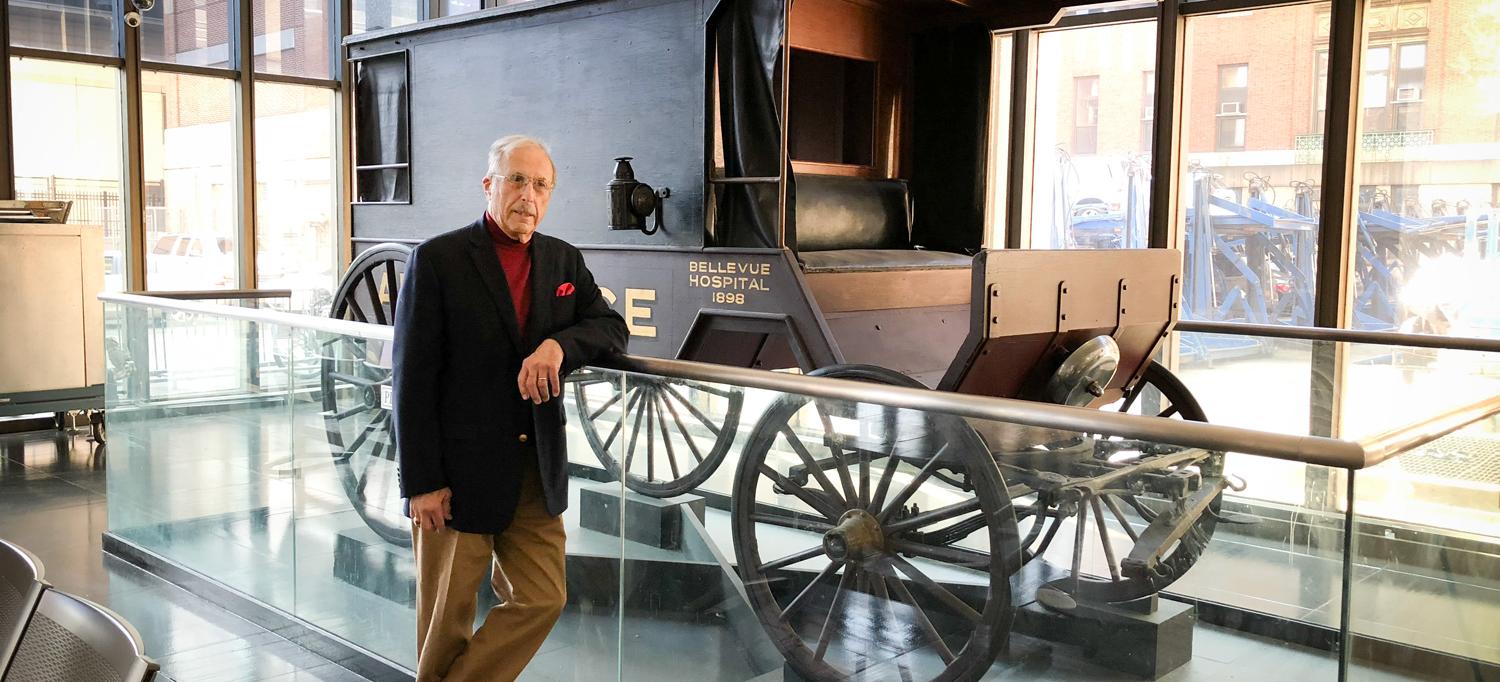
Robert Kravetz, MD, in front of the 1898 horse-drawn carriage that was part of the ambulance fleet at Bellevue Hospital, where he received much of his medical training.
Courtesy of Robert Kravetz, MD
When Robert E. Kravetz, MD, a 1958 graduate of NYU Grossman School of Medicine, attended his 60th class reunion in 2018, he made sure to have his picture taken standing beside an 1898 horse-drawn carriage that was once part of the ambulance fleet at what is now NYC Health + Hospitals/Bellevue. Dr. Kravetz, 92, felt a personal connection to the vehicle. An avid collector of medical artifacts from the 19th and early 20th centuries, he owns a cap worn by one of the ambulance drivers. As an alumnus who received his clinical training at Bellevue Hospital, NYU Langone Health’s longtime primary teaching affiliate, Dr. Kravetz says the antique brought back fond memories of his time at what was then known as New York University College of Medicine.
Dr. Kravetz marveled at how much had changed on campus since his previous reunion in 2008. But he was also struck by what had not changed: NYU Langone’s commitment to humanistic medicine, an approach to care that prioritizes compassion, empathy, and respect for the patient as a whole person. As a student, he was introduced to the concept by Lewis Thomas, MD, the renowned humanist and acclaimed author who was then chair of the Department of Pathology and later became the school’s dean.
At his reunion in 2018, Dr. Kravetz was heartened to learn that David M. Oshinsky, PhD, a Pulitzer Prize–winning author, is director of the Division of Medical Humanities in the Department of Medicine, and that one of his dear friends and schoolmates, the late Jerome Lowenstein, MD, had founded the school’s Humanistic Medicine Program, which set a national standard for humanistic medical education.
Dr. Kravetz has made his own contributions to humanistic medical education. He serves as clinical professor of medicine, bioethics, and humanism at the University of Arizona College of Medicine—Phoenix. He joined its faculty in 2012, five years after the school was established, and is now its most senior professor. He teaches a course on clinical medicine to first- and second-year students and an elective on the history of medicine to fourth-year students, with no plans to stop anytime soon.
Dr. Kravetz says his early clinical experiences shaped what would become a hallmark of his teaching and a guiding principle of his practice. “My medical school education and training took place during the golden age of medicine,” he notes. “There was a harmonious blending of technology and the human touch.” During his internal medicine residency in Brooklyn, Dr. Kravetz put what he had learned about the intimacy of the doctor-patient relationship into practice, making house calls for $5 per visit. “I brought my little black bag, a few medications, and my brain to listen to the patient’s story,” he recalls. Dr. Kravetz believes that every physician should develop their own technique for building trust with patients, and that small gestures—active listening, making eye contact—can go a long way toward fostering a connection.
Growing up in Jersey City, New Jersey, young Bob Kravetz was an Eagle Scout who won competitions for his expertise in delivering first aid, foreshadowing his career as a caregiver. He was inspired to become a doctor by his uncle George, a general practitioner in Brooklyn who took his time getting to know each patient. At the end of his second year at Rutgers University, he applied to New York University College of Medicine and was accepted within a week.
In 1961, Dr. Kravetz joined the United States Public Health Service, serving at the Phoenix Indian Hospital, a referral center for patients from Colorado, Utah, Arizona, and New Mexico. “It was like having two more years of training,” he says. “I traveled to the reservations and learned about Native American cultures.” Dr. Kravetz was also educated about the population’s state of health. “They had virtually no heart disease and very few cases of cancer,” he notes, “but they had a very high incidence of diabetes and alcoholism, the most common causes of death in those communities.”
Dr. Kravetz believed there had to be a better way to care for patients afflicted with alcoholism than to simply treat the end result of their illness—typically, cirrhosis of the liver or liver failure. While on staff at a county hospital in Phoenix, he established Arizona’s first rehabilitative clinic of its kind, the Center for Liver Disease and Alcoholism.
Dr. Kravetz completed a fellowship in gastroenterology at Yale School of Medicine, where he trained with another distinguished humanist, Howard Spiro, MD, founder of the school’s Program for Humanities in Medicine. In 1965, he returned to Phoenix with his wife, Nancy, an artist, to open a private practice. They met when seated next to each other at a wedding, and three dates later they were hosting their own matrimonial ceremony. Married for 69 years, they have three children and nine grandchildren and have visited 40 countries together. Their eldest son, Michael, is a retired specialist in rehabilitation medicine.
On his 65th birthday in 1999, Dr. Kravetz retired from private practice after 35 years. Last year, he was honored by the American College of Gastroenterology with the President’s Special Recognition Award for his “outstanding and substantial contributions to recognizing and preserving the rich history of clinical gastroenterology.”
Upon retirement, Dr. Kravetz pursued his interest in the history of medicine with characteristic zeal. He has collected thousands of medical artifacts, starting with the 25-cent purchase of a porcelain toothpaste jar from a thrift shop, and is always on the lookout for objects that, he says, “represent a window into the past and a reminder of how far we’ve come in medical diagnosis and treatment.” He has donated most of the artifacts, some of which are on display at the Robert Kravetz MD Medical Museum at the University of Arizona College of Medicine. Dr. Kravetz gives each graduating medical student in his course an antique related to their chosen specialty so they can start their own collection.
“I look at each day as an exciting challenge and opportunity,” says Dr. Kravetz. “I’ve had one wife, one house, one practice, and a lifetime of happy memories. I look forward to my 70th class reunion in 2028.”