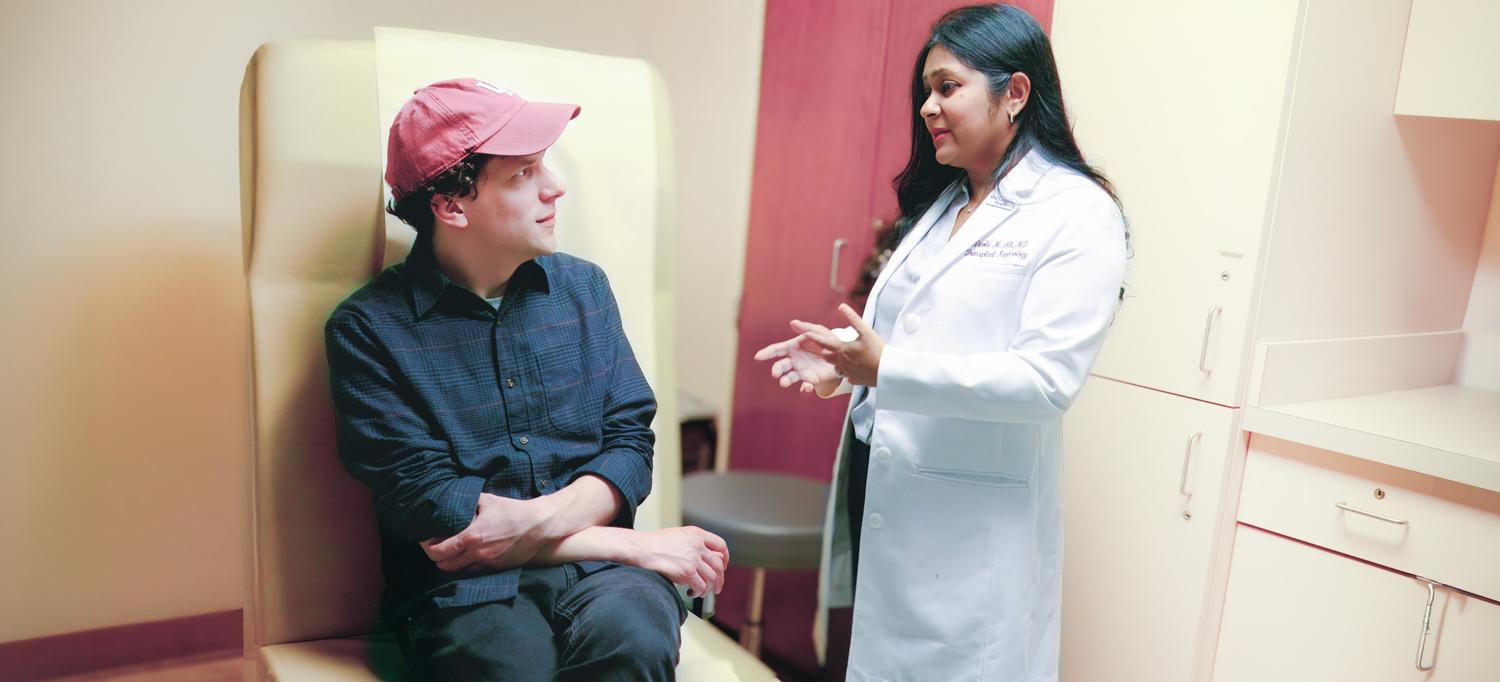
The transplant team at NYU Langone “make you feel like what you are doing matters, because they recognize that you are filling a great need,” says Eisenberg, shown here with Dr. Nicole M. Ali, medical director of the Kidney Transplant Program.
Credit: NYU Langone
Nearly 90,000 Americans are waiting for a kidney transplant and an average of 13 die every day while waiting. Most face a wait of three to five years or longer, spending hours each week tethered to a dialysis machine while they wait.
Jesse Eisenberg, the Academy Award–nominated actor, playwright, and filmmaker, didn’t know anyone on that list. He simply decided he wanted to help. On December 30, 2025, he donated one of his kidneys to a stranger at NYU Langone Health, an act known as an altruistic, or nondirected, donation. It’s a choice that changes a life; it’s also safer, and more accessible, than most realize.
Months after surgery, Eisenberg has experienced no lifestyle changes, no limitations—and no regrets. “I wish I had more kidneys to give,” he says.
What Is Living Kidney Donation?
Most people know you can register to be an organ donor after death. But you can also donate a kidney right now—while you’re perfectly healthy—to someone you’ve never met.
Eisenberg discusses his decision to become an altruistic kidney donor and why he chose NYU Langone for the procedure.
With living kidney donation, a healthy person donates one of their kidneys to someone in need. The most common way to donate is a direct donation to someone you know: a family member, friend, or co-worker. But you can also donate to a stranger through nondirected donation, like Eisenberg, where a kidney is matched to the best available candidate. In some cases, the donated kidney becomes the first link in a chain, resulting in multiple transplants.
After donation, the remaining kidney grows to take on the work of two, and the donor goes on to live a completely normal life. In 2025, more than 7,200 transplants were made possible by living donors, and kidneys from living donors typically last longer in recipients than those from deceased donors.
Learn more about becoming a living kidney donor or a living liver donor.
“Receiving a nondirected donor transplant is like winning the lottery,” says Nicole M. Ali, MD, a transplant nephrologist at NYU Langone who specializes in living-donor kidney surgery. She points to a patient in his 40s who had spent years on dialysis, working night shifts just to accommodate his treatment schedule. After receiving a donor kidney, he came off dialysis almost immediately. “It gives the recipient their life back so quickly,” she says.
What Happens When You Decide to Donate a Kidney
What surprised Eisenberg most about the process wasn’t the surgery or recovery. It was how easy, even enjoyable, the evaluation process turned out to be. Every donor is screened by a team of doctors, psychologists, and former donors, all working to ensure the donor is medically fit and emotionally prepared to donate. “Going through all of these medical tests—and coming out with a clean bill of health—only made me more eager to donate,” he says. “Every test confirmed that I was healthy enough to give someone else a chance at life.”
Can anyone donate a kidney? The evaluation process is open to most healthy adults. Conditions that might prevent donation include uncontrolled high blood pressure, diabetes, significant obesity, certain kidney conditions, or a history of some cancers. “Many medical conditions are not necessarily a barrier,” says Dr. Ali. “Those risks can be carefully assessed and managed.”
In addition to a medical evaluation, donors meet with psychologists to make sure they are going in with the right intentions and feel supported along the way. “If there’s any mental health history or concerns that come up, they’re referred to our transplant psychiatrists for further evaluation and support,” adds Dr. Ali.
That support, says Eisenberg, extends well beyond the evaluation. From his coordinator, who set up every appointment around his schedule, to his surgeon checking in by phone after surgery, the transplant team made the experience feel personal. “They make you feel like what you are doing matters, because they recognize that you are filling a great need,” he says.
Is Kidney Donation Safe?
That is the question most people have, and the answer, according to Dr. Ali, is a clear yes.
“Living kidney donation is extraordinarily safe,” she says. “We do such a thorough workup that if someone clears the evaluation and is approved to donate, it means they are actually healthier than the general population, with a lower risk of developing kidney disease.”
As with any surgery requiring general anesthesia, there are standard risks involved in kidney donation, but these are carefully assessed during the donor evaluation to ensure the procedure is safe for every individual.
One common fear: Will donating a kidney shorten your life? The answer is no. For donors who pass the evaluation, long-term health outcomes are excellent—in fact, research shows that donors often outlive their nondonor peers.
Kidney Donation Surgery and Recovery: What to Expect
The surgery is typically performed laparoscopically, with small incisions. Most donors spend one or two days in the hospital, with some going home the day of surgery. Regular activity can be resumed in a short period of time: Donors can typically return to work within two weeks. Those who do heavy lifting are advised to wait four to six weeks to reduce the risk of hernia. A follow-up visit happens around the two-week mark, with continued monitoring after that.
Eisenberg’s experience tracks closely with that timeline. He was up and walking the day after surgery. By week two, he was back on the subway. By week six, he was lifting his child and biking through New York City.
The one thing that caught him off guard? Pain—not at the incision site, but in his upper shoulders. “It felt like a muscle ache you’d get after throwing a football around,” he says. “That was the extent of my pain.”
Dr. Ali explains this is a common complaint after any laparoscopic surgery. “It’s ‘referred pain’ from air introduced to the abdomen that settles under the diaphragm,” she says. “It resolves within a couple of days.”
Months out from surgery, Eisenberg puts it simply: “My life is completely as it was before I donated. I don’t even notice my scars anymore.”
How to Become a Living Kidney Donor
The process is more straightforward—and faster—than you might think. For Eisenberg, the timeline from first conversation to surgery was a matter of months. It starts with a confidential call or email to the NYU Langone Transplant Institute team, followed by a thorough medical and psychosocial evaluation. If cleared, you’re matched to a recipient and scheduled for surgery.
Would Eisenberg do it again? Without hesitation.
“To me, it was a no-brainer,” he says. “My sacrifice was a brief hospital stay, a week of discomfort, and five weeks of not picking up my kid. If you like the idea of extending somebody’s life—of making somebody’s difficult existence feel livable again—it’s worth considering.”
For those curious about their recipient, there is an option to connect after donation, though it’s entirely voluntary. Both parties must opt in, and communication typically starts anonymously through the transplant institute. Some donors and recipients do eventually meet.
What Eisenberg hopes, above all, is that his story makes the idea feel accessible. “I think I seem like a regular person, not a tough guy,” he says. “So if people see that I did this with no difficulty, maybe it makes it seem doable for them too.”
To explore living kidney donation at NYU Langone—the No. 1 kidney transplant program in New York State, and No. 2 in the nation—call 212-263-3621 or email NYUTrLivingDonor@NYULangone.org.