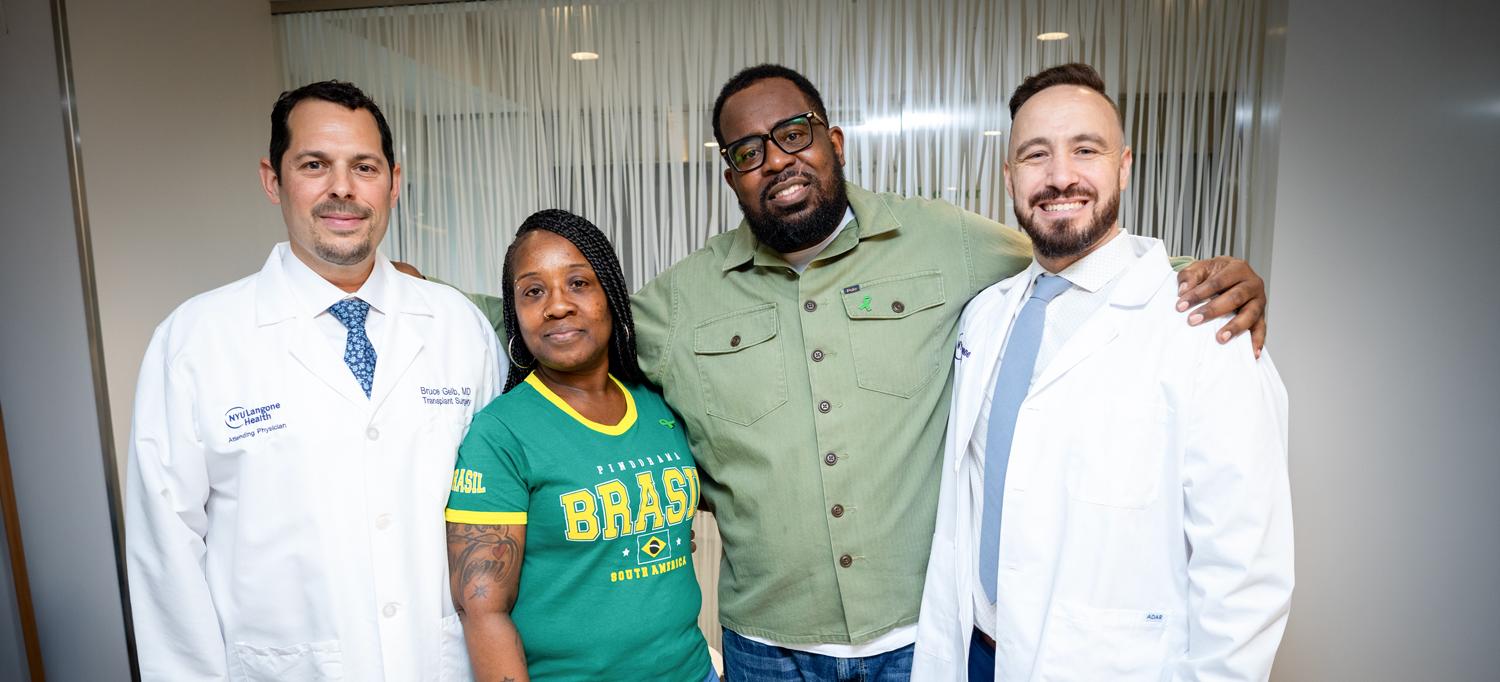
Kim and Troy Rowe with their transplant surgeons Bruce E. Gelb, MD, and Ryan P. Robalino, DO.
Credit: NYU Langone Health
When Troy Rowe, 49, learned he would need a kidney transplant, he was reluctant to ask anyone in his life if they would be willing to donate. But his community rallied behind him, and more than 20 people volunteered to be tested. Ultimately, his best match came from a member of his own family: his older sister, Kim Rowe, 52. On February 2, 2026—Troy’s birthday—the siblings walked arm in arm into NYU Langone Health, where their care teams performed the transplant that would save Troy's life.
“It was the ultimate birthday gift,” said Kim. “I would do it all again in a heartbeat.”
Troy, a superintendent at the Metropolitan Transportation Authority, found out his kidney function was declining during a routine physical in 2024. His doctor warned him that his condition would worsen and that he would eventually require a transplant.
As he began the process of joining the national kidney transplant waitlist, Troy chose NYU Langone for his care. In March 2025, he met with nephrologist Lionel E. Desroches, MD, for further evaluation. After reviewing updated test results, Dr. Desroches identified a sharp decline in Troy’s kidney function and directed him to the emergency room immediately, telling him “I’ll meet you there.”
Troy was diagnosed with end-stage kidney disease due to hypertension. He started dialysis, a treatment that filters toxins from the blood when the kidneys can no longer do so.
“I had an idea in my head of what dialysis would be like,” said Troy. “But I was able to have a flexible schedule, so my treatment didn’t interfere too much with my day-to-day life.”
While undergoing treatment, Troy sent out a survey to his friends and family to see if anyone could be a potential donor. Because his blood type, B positive, is less common, he knew finding a match could be a challenge.
His sister, Kim, had the same blood type and higher-than-usual biological compatibility. Known as a low eplet match, this level of compatibility is associated with a higher likelihood of transplant success and kidney function.
“I was shouting from the rooftops when they told me I was Troy’s match,” recalled Kim. “I even told him before his doctor did—I was just so excited.”
After initial testing confirmed their compatibility in August 2025, Kim had a full medical evaluation—including a physical exam, colonoscopy, and mammogram—to ensure she could safely donate. Once she was cleared, the surgery was scheduled for Troy’s birthday the following February.
“When we found out the surgery would be on Troy’s birthday, we took it as a good sign and a blessing,” said Kim.
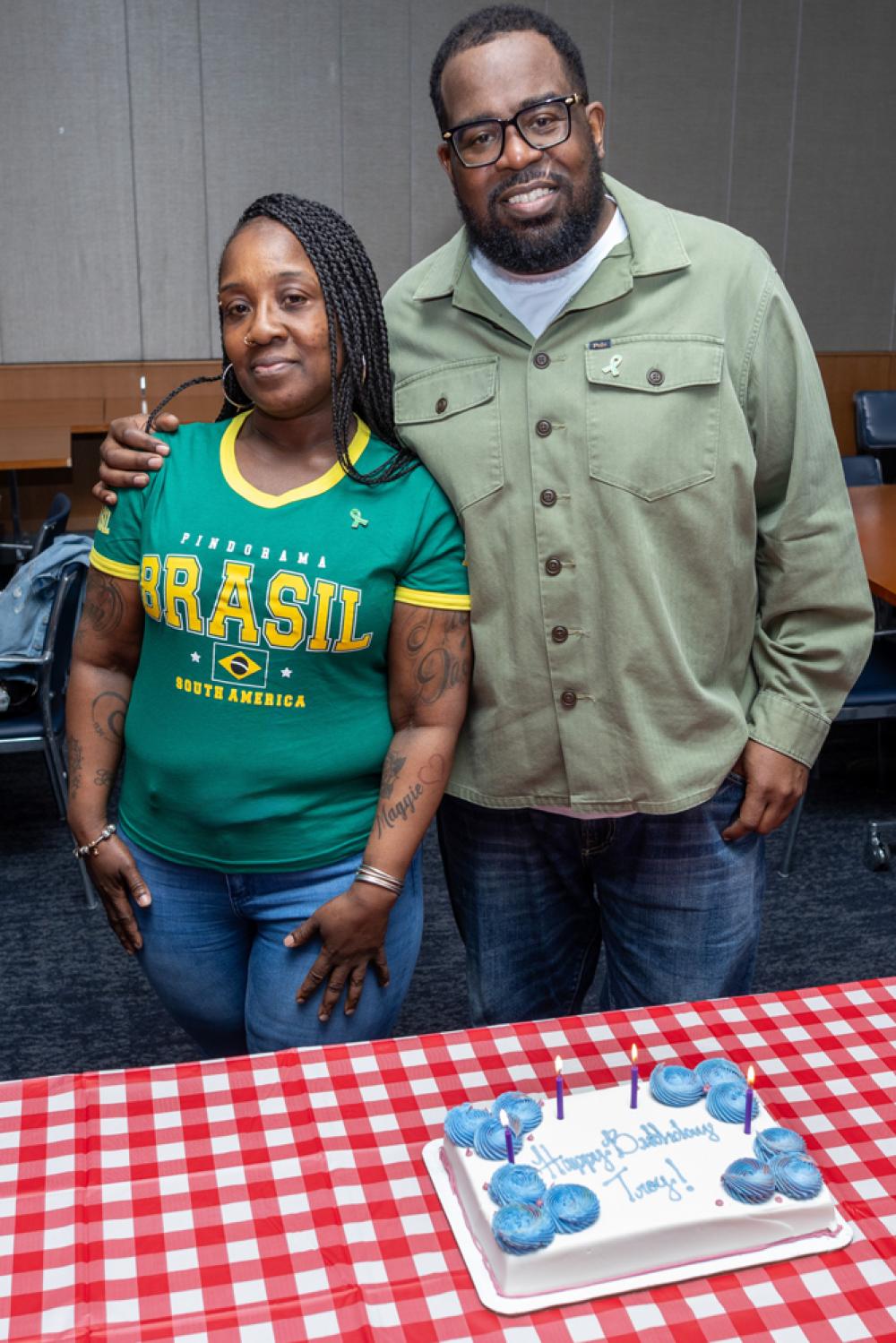
Kim and Troy celebrate Troy’s 49th birthday after the surgery.
Credit: NYU Langone
During surgery, Kim’s care team, led by Bruce E. Gelb, MD, associate professor and vice chair of quality in the Department of Surgery and a surgeon at the NYU Langone Transplant Institute, worked meticulously to remove scar tissue from a prior abdominal procedure.
“Kim remained positive throughout every step of this journey,” said Dr. Gelb. “Her story highlights that living donation, while a significant commitment, can be an incredibly rewarding and joyful experience.”
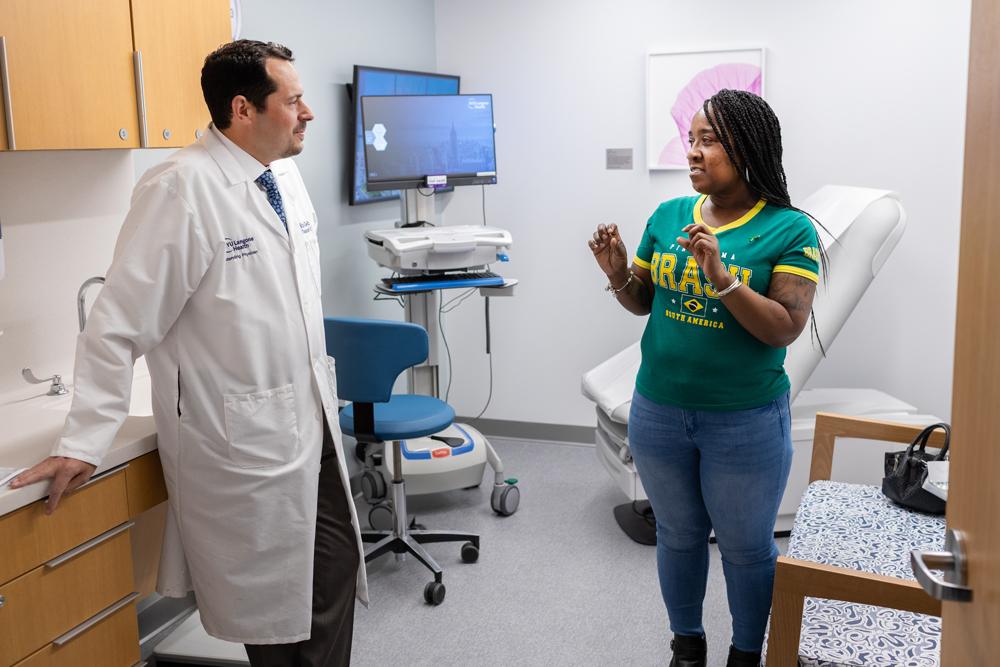
Kim meets with her transplant surgeon, Dr. Gelb, for a follow-up appointment.
Credit: NYU Langone
Troy’s transplant surgery was performed by transplant surgeon Ryan P. Robalino, DO, clinical assistant professor in the Department of Surgery. Within about three weeks, Troy started to feel like himself again. The siblings have stayed in close contact throughout their recovery and reunited to celebrate Kim’s birthday in March.
“The best way to restore Troy’s quality of life was through a transplant,” said Dr. Robalino. “Without a direct donor, he could have spent years of his life on dialysis. It’s very special that so many people in his community stepped forward, and that his sister was an excellent match.”
As they continue to recover, both Troy and Kim attend regular follow-up appointments with their care teams. At the six-month mark, Troy’s care will transition back to Dr. Desroches, who will oversee his long-term kidney health and medications.
“I’m grateful to be alive and healthy, and that my big sister had my back through it all,” said Troy. Kim echoed his sentiment: “I know if the roles were reversed, my brother would have done the same for me.”
Learn about NYU Langone’s Kidney Transplant Program and how to become a living donor.
About NYU Langone Health
NYU Langone Health is a fully integrated health system that consistently achieves the best patient outcomes through a rigorous focus on quality that has resulted in some of the lowest mortality rates in the nation. Vizient Inc. has ranked NYU Langone No. 1 out of 118 comprehensive academic medical centers across the nation for four years in a row, and U.S. News & World Report recently ranked four of its clinical specialties No. 1 in the nation. NYU Langone offers a comprehensive range of medical services with one high standard of care across seven inpatient locations, its Perlmutter Cancer Center, and more than 320 outpatient locations in the New York area and Florida. The system also includes two tuition-free medical schools, in Manhattan and on Long Island, and a vast research enterprise.
Media Inquiries
Casey Nicholl
Phone: 646-983-4920
Casey.Nicholl@NYULangone.org