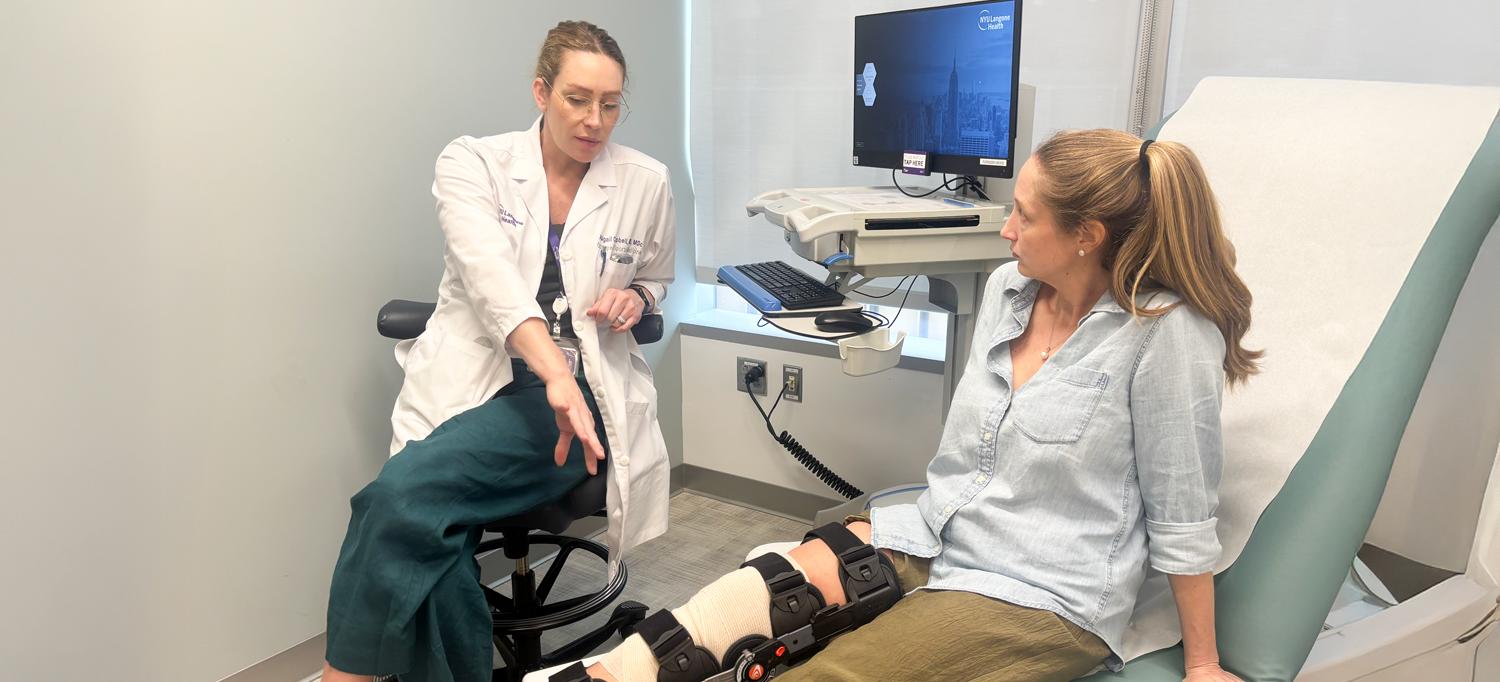
Dr. Abigail Campbell explained to Katharine Johnson that for knee surgery performed before 20 weeks, NYU Langone has developed a rigorous safety protocol to avoid general anesthesia.
Credit: Marlene Naanes
Katharine Johnson was six weeks pregnant in February 2025 when she and her husband, Sean, embarked on a ski trip to Japan. Her obstetrician–gynecologist had assured her there was little risk to the fetus at such an early stage of gestation if she took a tumble on the slopes. But an injury that resulted from such a fall complicated her pregnancy in ways she couldn’t have imagined.
On the morning of February 25, Johnson, a 38-year-old digital marketer who lives in Hoboken, New Jersey, took what seemed to be a minor spill on a back-country trail—until she tried to stand up. “I heard a pop, and then a bolt of pain shot up my right leg,” she recalls. She was airlifted to a hospital, where an X-ray indicated a probable tear in her knee. Daunted by the language barrier, she was unable to obtain a more precise diagnosis and opted to wait until she returned home before seeking medical care. The knee hurt only when she put weight on it, so she was able to spend the week sightseeing, aided by a brace and crutches.
When Johnson underwent an MRI at another health system in Manhattan, in mid-March, it revealed two serious problems: a ruptured anterior cruciate ligament (ACL), the band of tissue that connects the thigh bone to the shinbone, and a torn medial meniscus, a wedge of cartilage on the inner side of the knee that acts as a shock absorber and stabilizer between those bones. The first orthopedist she consulted said she would require surgery, but unfortunately, he added, his facility was not equipped to operate on pregnant patients. A second surgeon explained that her medical center’s anesthesia team refused to perform such procedures, deeming the risks to the fetus to be too high. She advised Johnson to wait until after she’d given birth.
For Johnson, an avid runner and skier, the prospect of being sidelined for more than seven months was unacceptable. Moreover, she wondered how she would manage during the rest of her pregnancy without being able to walk unassisted, and how she would care for a newborn while recovering from knee surgery. “It was so frustrating,” she says. “I called multiple orthopedic surgeons in New York City, but one after another declined.”
Finally, Johnson reached out to Abigail L. Campbell, MD, at NYU Langone Health, whose Department of Orthopedic Surgery is rated No. 2 in the nation by U.S. News and World Report’s “Best Hospitals” rankings. “I left a message describing my situation, not really expecting to hear back,” Johnson says.
Dr. Campbell, though, was eager to help. Before joining NYU Langone in 2023 as director of the Center for Women’s Sports Medicine, she had successfully completed a similar surgery on another pregnant patient. “Although many surgeons are uncomfortable performing orthopedic procedures during pregnancy,” she explains, “research over the past decade has shown they can be done safely.”
Dr. Campbell also had two things in common with Johnson. She, too, was a lifelong athlete who found exercise crucial to her physical and emotional wellbeing. “As an active person and former college athlete, I have experienced many of the injuries that I manage in the people I care for,” she says. Beyond this, she herself was pregnant at the time. “When Dr. Campbell called me and said, ‘Tell me your story,’ ” Johnson recalls, “I was so grateful that I broke down in tears.”
After meeting with Johnson and examining her scans, Dr. Campbell concluded that operating promptly was the wisest course of action. “When you have a ruptured ACL, it makes the knee unstable, which can further damage the articular cartilage and the meniscus,” she explains. “The longer you wait to address this kind of injury, the harder it is to completely fix it.” After discussion with colleagues in obstetrics, Dr. Campbell recommended surgery early in the second trimester. She planned to repair the torn cartilage and replace the ACL with a piece of tendon extracted from an uninjured part of her knee.
To minimize risks to Johnson and her baby, Dr. Campbell reached out to Justin Brandt, MD, director of the Division of Maternal–Fetal Medicine. “We never rush to perform surgery during pregnancy,” notes Dr. Brandt. “But we advocate for it strongly when the risks of not doing surgery outweigh those of doing it, and we’ve developed systems to ensure that it’s done safely.”
For procedures performed before 20 weeks of gestation, like Johnson’s, NYU Langone’s multidisciplinary team has developed a rigorous safety protocol. An anesthetic is injected directly into the cerebrospinal fluid, a procedure known as a spinal block, thus avoiding the risks of general anesthesia. Fetal heart rate is monitored pre- and postoperatively for signs of distress. Because pregnancy increases the risk of blood clots, patients are encouraged to start walking with assistance within hours after surgery.
On the morning of May 14, Johnson was wheeled into an operating room at Tisch Hospital. The three-hour procedure went well, and she was discharged that afternoon. She started rehabilitation at a facility in Hoboken a few days later, and within six weeks, she no longer needed crutches. After her son, Brody, was born on October 3, she carried him easily up the two flights to their apartment. By then, Dr. Campbell’s daughter, Louise, was 10 weeks old, and doctor and patient were soon sending each other baby pictures.
Today, Johnson is training for her first 5K run since the accident. She remains grateful to the surgeon who accepted her case. “After all those doors had slammed in my face, Dr. Campbell’s opened,” she says. “I can’t say enough about what she did for me.”