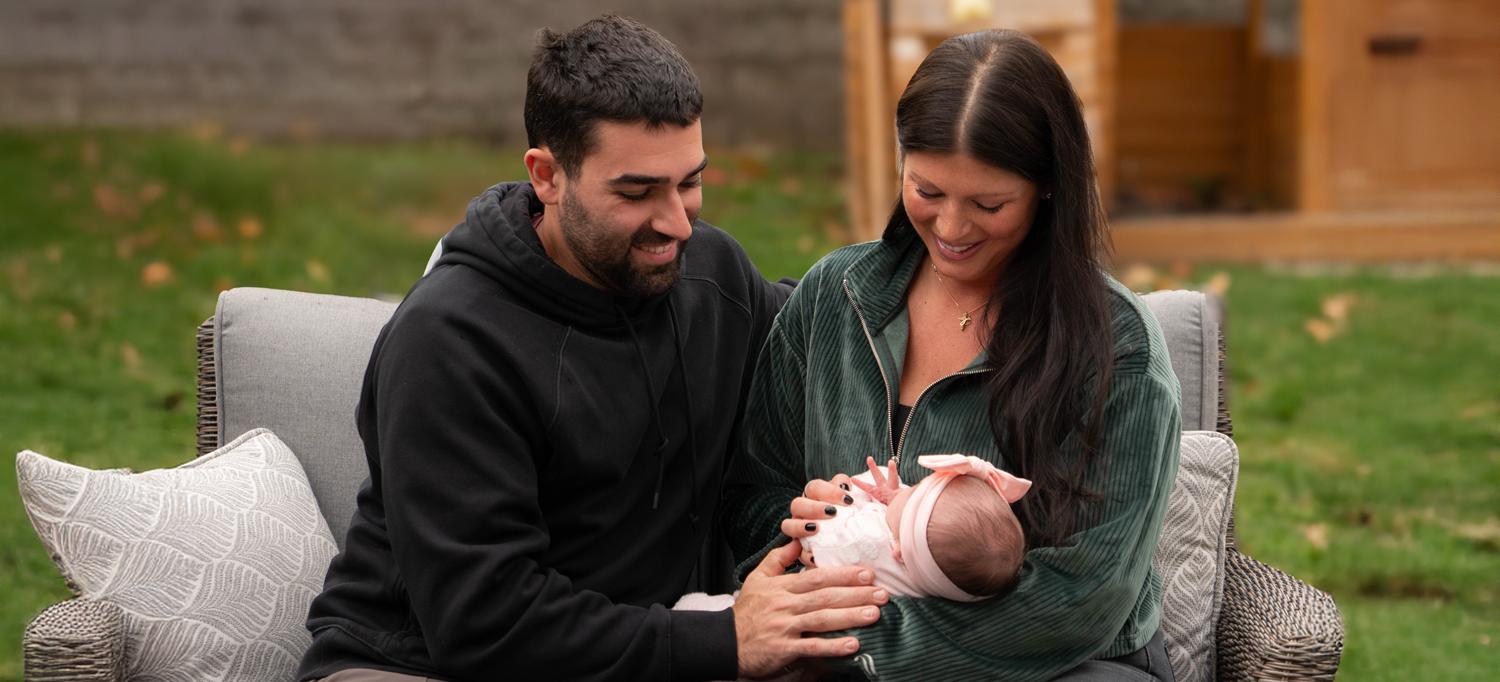
Perlmutter Cancer Center is one of the few institutions of its kind with the expertise and experience to treat pregnant women who have breast cancer. “I feel tremendously lucky that I came here, says Christina Sanz, shown with her husband, Jeremy, and their baby, Isabella.
Courtesy of Christina Sanz
When Christina Sanz found a lump in her right breast during a self-exam in January 2025, she feared not only for her own health, but also for that of her unborn baby. Christina, 32, a small-business owner who lives in Yonkers, New York, with her husband, Jeremy, and their 4-year-old son, Grey, had learned she was pregnant just a week earlier. Now, her joy and excitement were tinged with dread: “What if it’s cancer?” she thought.
Christina’s obstetrician–gynecologist advised her to get a mammogram, a test not typically recommended until age 40, when breast cancer becomes more common. The test showed a possible abnormality, leading to a biopsy that revealed early-stage cancer. To Christina’s dismay, another institution declined to treat the disease while she was carrying a fetus, citing a lack of specialized maternal–fetal expertise. “My husband and I had longed for this child,” she says. “Terminating the pregnancy was out of the question.”
Though the rate of breast cancer at younger ages is rising for reasons that are not clear, the disease occurs in only about 1 in 3,000 pregnancies. When it does, few hospitals possess the teams of specialists needed to ensure a successful outcome for both mother and baby. Fortunately, Christina found her way to NYU Langone Health’s Perlmutter Cancer Center, a National Cancer Institute–designated Comprehensive Cancer Center, which offers a coordinated, multidisciplinary approach to such complex cases.
Christina and Jeremy met with Mary Gemignani, MD, MPH, chief of the Division of Breast Surgery. Dr. Gemignani, director of Perlmutter’s new Early Onset Cancer Program, is an internationally recognized leader in developing standards of care for breast cancer. “We strive to treat the whole patient, not just the disease,” she says. “Our initial discussion centered on making sure that Christina’s goal of keeping her baby was aligned with the goal of treating her cancer successfully.”
Dr. Gemignani explained that Christina could choose to undergo either a lumpectomy (also known as breast-conserving surgery) or a full mastectomy. Such procedures are generally scheduled for the second trimester, when the risk of miscarriage is lower. Similarly, many types of chemotherapy can be started at that stage without endangering the fetus.
To oversee Christina’s nonsurgical treatment, Dr. Gemignani teamed up with medical oncologist Elizabeth Comen, MD, a renowned breast cancer researcher and co-director of NYU Langone’s Mignone Women’s Health Collaborative. Dr. Comen ordered new tests on Christina’s biopsy sample. They revealed that the cancer was driven by a genetic mutation that made it vulnerable to a combination of chemo and two targeted therapies, drugs that attack proteins, or pathways, involved in cancer development to prevent their growth.
Dr. Comen provided emotional support as well, frequently checking in with Christina by phone or email. “Breast cancer is such a traumatic diagnosis—even more so when you’re bringing a new life into the world,” she says. “It’s a privilege to provide tender care during a very delicate time.”
Dr. Gemignani tapped Justin Brandt, MD, director of the Division of Maternal–Fetal Medicine, who has a particular interest in caring for pregnant people with cancer, to coordinate efforts to battle Christina’s cancer with those aimed at ensuring a safe, successful labor and delivery. “[Maternal–Fetal Medicine] speaks the language of pregnancy and cancer,” Dr. Brandt explains. “We play a critical role in bringing together the care teams on both sides of the equation.”
Christina ultimately chose to undergo a mastectomy. During the weeks leading up to the procedure, Dr. Brandt consulted on the surgical plan and the postsurgical medication regimen. His team performed pre- and postoperative fetal monitoring and observed the operation, performed by Dr. Gemignani on March 19 at Tisch Hospital; it went smoothly. Then, plastic surgeon Jamie P. Levine, MD, chief of microsurgery, completed reconstructive surgery. Christina returned home the next morning and was able to resume normal activities within a few days.
Then came six months of chemo, accompanied by the nausea and fatigue commonly associated with such treatments. Jeremy and both sets of in-laws helped with childcare and errands. “It takes a village,” she says. Despite Christina’s suffering, tests showed that her baby was doing fine.
In late August, Dr. Comen suspended treatment in preparation for the delivery. On September 25, after an obstetrical exam showed that birth was imminent, Christina checked back into the hospital. The next day, with Jeremy looking on, a healthy girl named Isabella entered the world.
“She’s beautiful, feisty, and fierce,” says Christina, who recently completed chemotherapy and remains on targeted drugs aimed at preventing her cancer from recurring. Christina is grateful to the clinicians who gave her and her daughter the chance to live and thrive. “Everyone I’ve met at NYU Langone has been beyond phenomenal,” she says. “I feel tremendously lucky that I came here.”