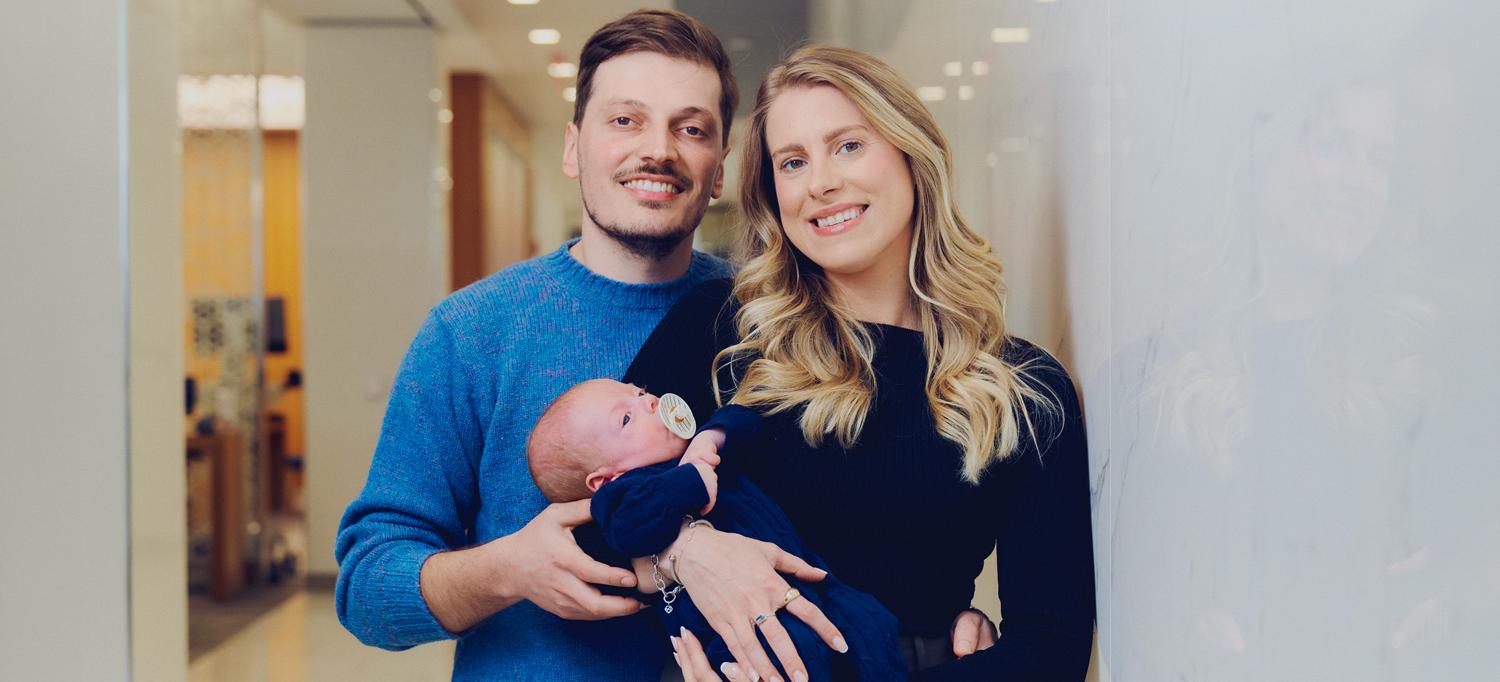
Emily Sammartano and Sean Cirillo are deeply grateful for their infant son, Leonardo—and Emily’s restored health following a kidney transplant.
Credit: Joe Carrotta
Growing up as the youngest of four children in Oceanside, Long Island, Emily Sammartano had always dreamed of starting a family of her own. But when she and her fiancé, Sean Cirillo, married in June 2024, they knew their path to parenthood might not be an easy one. Six months earlier, after a routine screening detected alarmingly high blood pressure, Sammartano was diagnosed with a rare autoimmune disease known as IgA nephropathy.
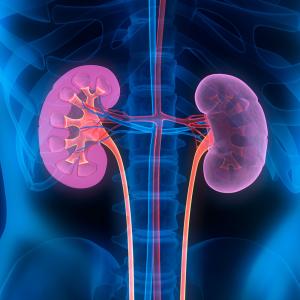
“The first question I asked was, ‘Can I have kids?’” she recalls. The answer, she learned, was maybe. IgA nephropathy occurs when the immune system attacks capillaries in the kidneys that filter impurities from the blood. Although many patients with the condition have successful pregnancies, it increases the risk of preterm delivery and preeclampsia, a potentially life-threatening hypertensive disorder.
A former cross-country runner, Sammartano was exceptionally fit, and medications had helped stabilize her kidney function. Her doctors determined that she could safely attempt a pregnancy. However, they warned that she would have to stop taking the drugs that had halted her disease progression because they could be harmful to the fetus. Plus, the demands of pregnancy might further damage her kidneys. Sammartano accepted the risk. “I was willing to do whatever it took to have a baby,” she says.
Sammartano became pregnant in April 2025. Soon afterward, her NYU Langone–affiliated obstetrician-gynecologist, Matthew J. Dilena, MD, referred her to Nadia B. Kunzier, DO, a maternal-fetal medicine specialist at NYU Langone Hospital—Long Island, who oversees such complex cases. “Dr. Kunzier was incredibly supportive throughout my struggle,” says Sammartano. “She really took the reins.”
In June, lab results showed that her kidney function was declining rapidly. Dr. Kunzier consulted Naveed N. Masani, MD, medical director of dialysis services at NYU Langone Hospital—Long Island, who advised that Sammartano undergo a kidney biopsy. The test revealed that the decline was due to the physiological stresses of pregnancy, not due to increased disease activity. To mitigate the problem, she would receive dialysis, a treatment that filters waste products and excess fluids from the blood when the kidneys can’t do the job. Undergoing dialysis during pregnancy is uncommon, but successful outcomes have increased significantly in recent years.
At Dr. Kunzier’s suggestion, Sammartano began seeing nephrologist Stephen Yang, MD, who developed a treatment plan to accommodate the evolving needs of both mother and fetus. “He’s an unbelievable physician,” she says. “His combination of medical expertise and caring blew me away.”
Surgeons fitted Sammartano with a dialysis catheter in her chest rather than the conventional vein-to-artery connection in the arm, known as a fistula, because the latter can take up to three months to mature. In mid-August, she began a Monday-through-Saturday regimen at NYU Langone Dialysis Center—Bethpage, gradually ramping up to five hours per session, or 30 hours per week, which is roughly three times the typical duration for patients on dialysis. “We start out gently, increasing the intensity as the mother’s body changes,” explains Dr. Yang.
Meanwhile, Dr. Kunzier conducted regular lab tests and fetal sonograms, consulting with Dr. Yang and his team daily. “NYU Langone Hospital—Long Island is one of a select group of centers in the New York region equipped to guide a patient through a pregnancy as complex as Emily’s,” says Martin Chavez, MD, director of maternal-fetal medicine at the hospital. “Our combination of expertise, coordinated multidisciplinary planning, and empathetic care is what makes great outcomes possible.”
Sammartano, a compliance manager for a global financial firm, continued to clock in remotely while undergoing treatment. “My life was literally work, doctor appointments, and dialysis,” she says. “Nothing else existed.” The staff at the Bethpage center helped her maintain a positive attitude despite the anxieties, discomforts, and deprivations of her situation. Sammartano became especially close with nurse manager Patricia March, RN, and Gina Ferguson, LPN. “They became my second family,” says Sammartano. “When I was having a bad day, they made me laugh. They kept me strong and kept me going.”
March notes that unlike many dialysis programs, NYU Langone Dialysis Center relies on nurses rather than technicians to provide patient care. “We get to know our patients as people, not just cases, and we look after every aspect of their health, from their blood circulation to their emotional well-being.”
All along, the plan had been to induce labor at 37 weeks, once the baby was considered full term, to avoid the risks that continuing the pregnancy would pose to Sammartano’s health. On December 16, she underwent dialysis in the hospital’s delivery room in case the labor was protracted. She then received treatments to induce the process—and 12 hours later, a healthy boy, Leonardo, greeted his parents with a lusty wail. Sammartano developed preeclampsia soon afterward, but medications and another round of dialysis eased it. She went home with her newborn within two days.
The next step in the family’s journey began in February 2026, when Sammartano passed the evaluation for a kidney transplant, meaning she was a good candidate, and the procedure was deemed medically necessary. Cirillo offered to be the donor, but Sammartano’s exposure to his DNA through carrying his child would increase the risk of rejection. Instead, he signed up for a National Kidney Registry program that enables an individual to donate a kidney to a stranger, earning priority status for friends or family members who might need one. “I said, ‘Emily did her part for our family, and now I want to do mine,’” he recalls.
Cirillo donated his left kidney in March, and Sammartano received a kidney from an anonymous donor on April 30. Her three-hour surgery was led by Robert Montgomery, MD, DPhil, director of the NYU Langone Transplant Institute. A heart transplant recipient himself, Dr. Montgomery is a pioneer of techniques to improve access to donor organs, including “donor swaps” like the one Sammartano received, and the fast-advancing field of xenotransplantation, the use of organs from gene-edited animals.
“When I met Emily’s parents right before the surgery, they both cried and said they were so happy I was doing the transplant because I uniquely knew what their daughter had been through in terms of the uncertainty of receiving an organ in time,” says Dr. Montgomery.
The transplant was successful, and Sammartano went home on May 3, returning to her husband, her infant, and a brighter future than she could ever have imagined a year ago. “I’m excited to live my life again instead of watching it pass me by from the sidelines,” she says. “And I’m so grateful to everyone who made it possible.”