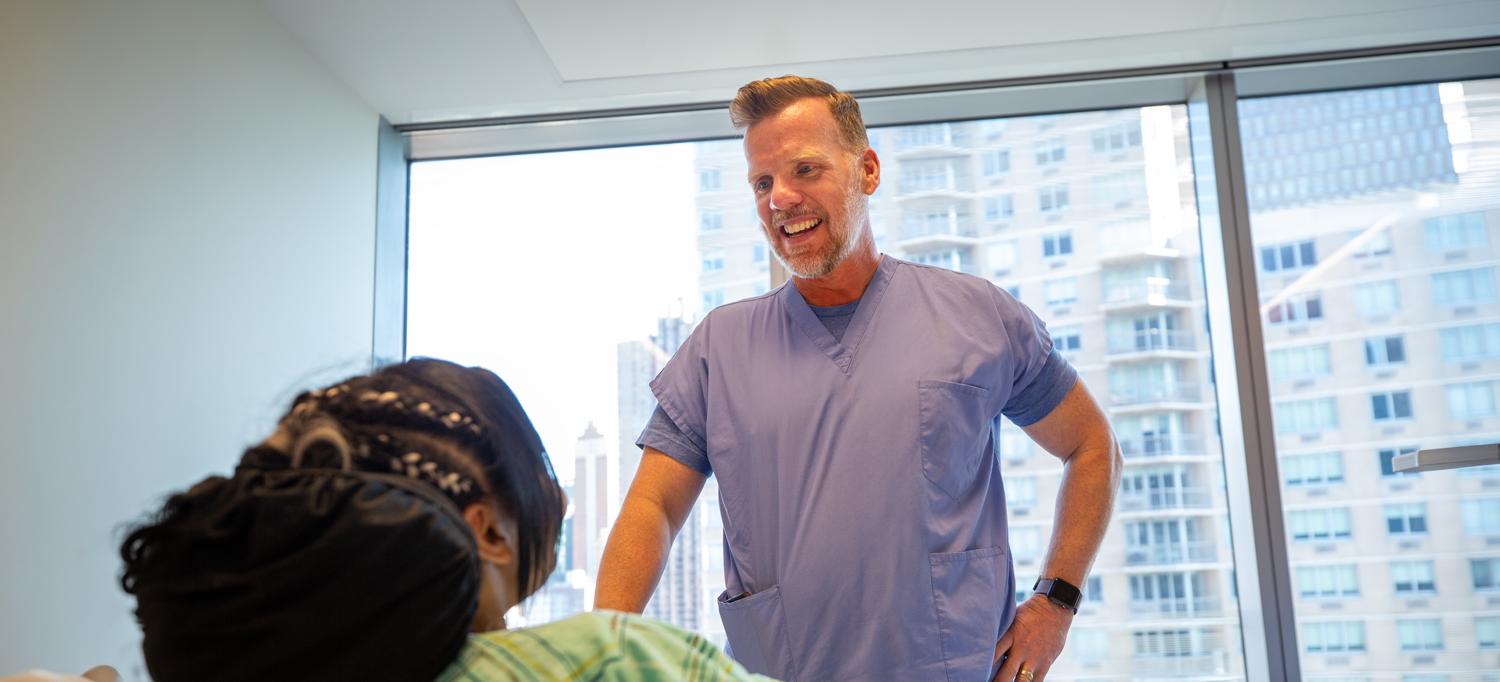
Kevin Moore, DNP, RN, started his next act after a career on stage and running birthday parties at an American Girl store in Manhattan. “Remember when you wanted to be a nurse?” he found himself thinking.
Credit: NYU Langone
While the usual conversation about our national nursing shortage focuses on how to recruit young people, there is another potential pipeline: people in their 40s and 50s—often pursuing a second career—who are also, in many ways, exactly the nurses that NYU Langone Health needs.
It’s easy to assume someone thriving in a career always knew where they were going, but some of the best nurses didn’t see it coming. For these four, strong support across the institution made all the difference.
“Our second-career nurses bring a depth of perspective, resilience, and purpose that strengthens our entire profession,” said Debra Albert, DNP, MBA, RN, chief nursing officer and senior vice president for patient care services at NYU Langone Health.
Eddie Rodriguez, MSN, RN, was writing traffic tickets in his 20s to people who had run red lights when he realized there was a gap between who he thought he’d be and how he was living day-to-day.
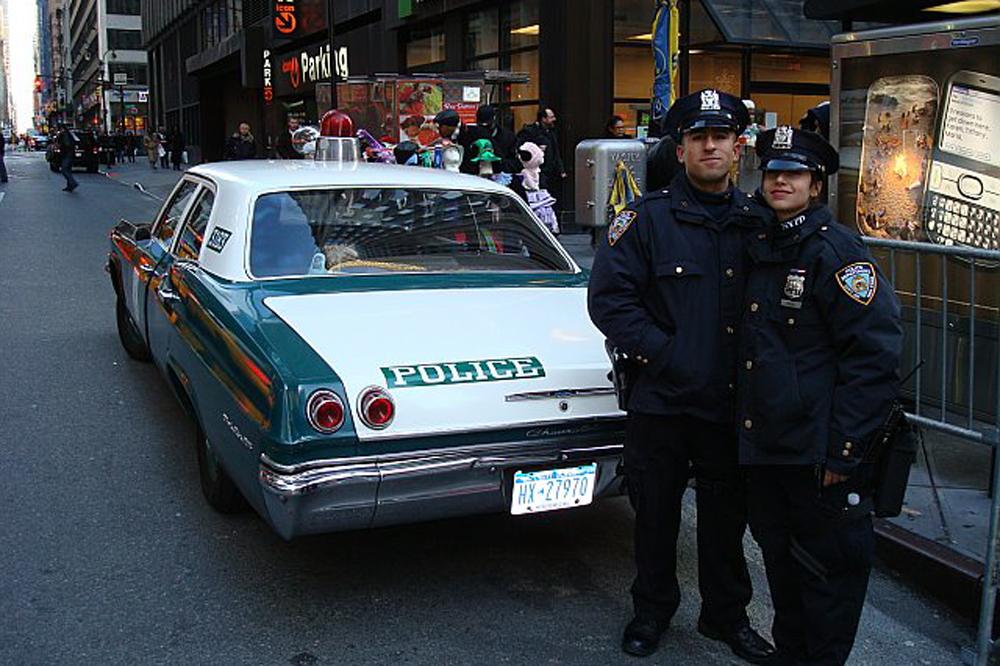
Going to nursing school at night while still a cop, Eddie Rodriguez, MSN, RN, saw his former coworkers getting promotions. “The dividends come later,” he told himself.
Courtesy of Eddie Rodriguez
“People were disappointed to see me,” he said. “That is not what I thought I was signing up for.”
Rodriguez had grown up wanting to work in a museum, but his father was a police officer, and the stability and possibility of helping people was attractive to him when he was young. When his father had a heart attack, Rodriguez spent days in the hospital watching nurses work to keep his dad alive. He also watched them sitting with his father after interventions, explaining how his life would need to change. Seeing this version of helping people brought Rodriguez’s career into focus.
With his father’s encouragement, he left the police department. He went to nursing school at night while working overnight ambulance shifts. As he saw former colleagues get promoted, he reminded himself, “The dividends come later.”
Today Rodriguez is the nurse manager for psychiatry at NYU Langone Hospital—Brooklyn, in a unit that runs above 93 percent occupancy and serves adult patients with mood disorders, psychotic disorders, personality disorders, and substance use issues, as well as people who don’t fit into a neat diagnostic box.
His hand, as he puts it, is in almost every cookie jar: patient care, risk, quality, patient safety, workplace violence training, finance, timekeeping. “I joined somewhere where I matter. Every day, it is fulfilling to be a part of what will happen next.”
“Nurses have so many more options and much more of a voice in care than most people outside the profession realize, and we see many second-career nurses discover that quickly," said Stephanie A. Nolan, DNP, MBA, RN, vice president of nursing and patient care services at NYU Langone Hospital—Brooklyn. “Second-career nurses often arrive with a level of emotional intelligence that is already fully formed. Our nurse residency program helps us nurture that, and over time, those nurses become the mentors and leaders ensuring the bedside perspective is in the room where decisions happen.”
While Rodriguez laid his nursing foundation at police academy, Kevin Moore, DNP, RN, was learning from some of the toughest critics: children at birthday parties.
In his 40s, Dr. Moore was coordinating birthday parties at the American Girl store in Manhattan. It wasn’t where he’d expected to land. He had spent his 30s performing. He did Shakespeare at the Flea Theater, got reviewed in The New York Times, played every kind of stage the city had to offer. When he and his husband bought a home in Jersey City, the relentless travel of a performer’s life became harder to sustain, and Dr. Moore found himself, for the first time, without a clear next act.
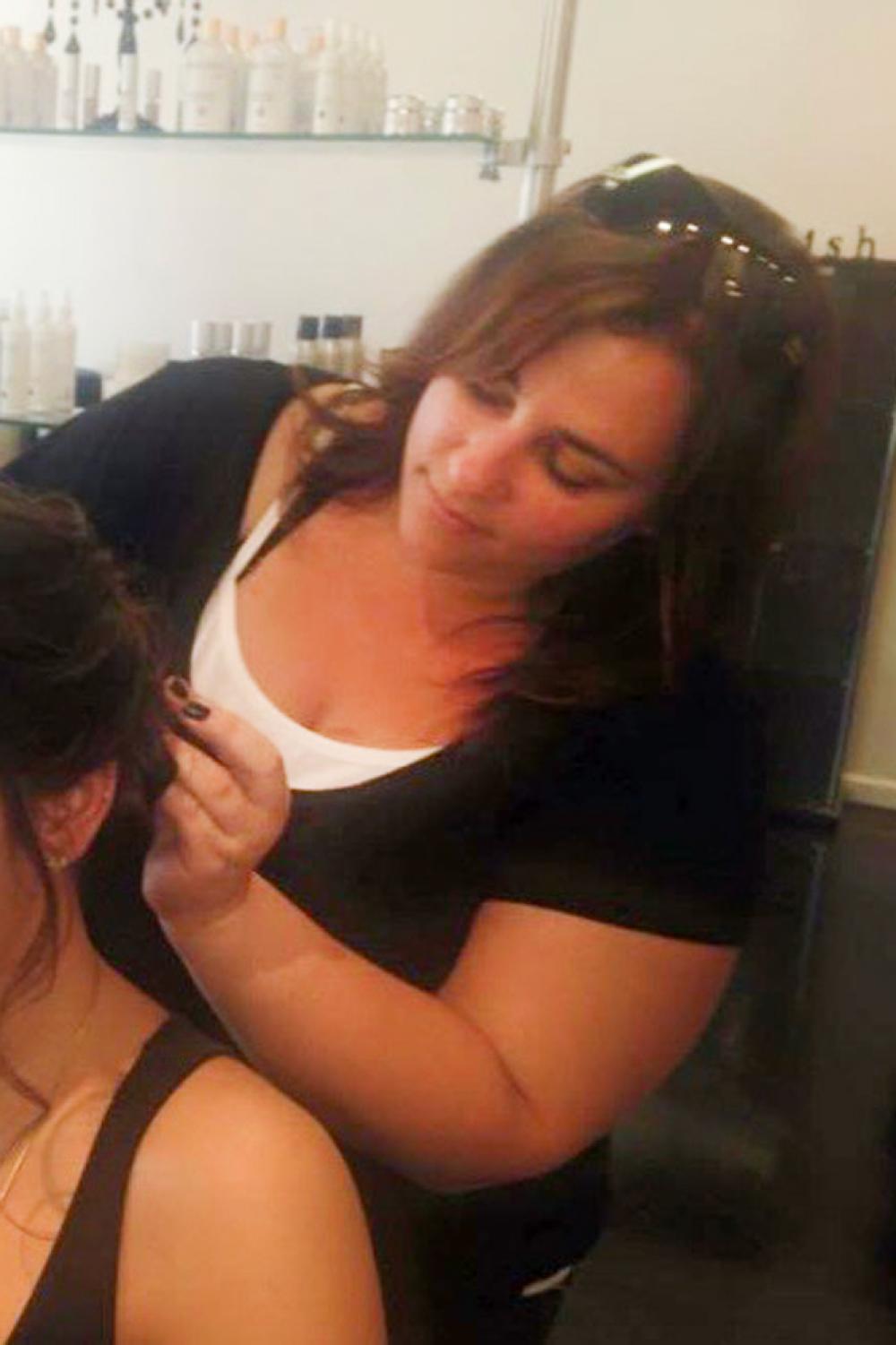
After Dr. Moore moved out of New York, all the travel that performing requires got harder to maintain.
Working at the American Girl store, he will tell you, is actually a great job. One day a mother called ahead to say her daughter had phenylketonuria, or PKU, a rare metabolic disorder that makes it impossible to digest protein. Even a trace of protein on a cook’s glove could send her child to the hospital. Dr. Moore went through every ingredient in the kitchen, worked with the staff to set up a dedicated safe area, and made sure the little girl had a perfect tea party for her birthday. The experience of helping remove a healthcare-related barrier so someone could safely and joyfully exist in a space remained with him.
Dr. Moore kept reflecting on what might be next. He started meditating and considering his career options: lawyer, accountant, something else? Then one morning, washing his hair, a thought arrived so clearly it almost had a voice: “Remember when you wanted to be a nurse?”
He had. At 13, he had told his mother exactly that. Wanting to protect him, she had said absolutely not—that was a woman’s job. He filed away the idea and built a different life. Now, standing in a bathroom in New Jersey some three decades later, the idea came back. “I was open,” he said. “The meditation was letting me process.”
He was finishing his prerequisites when his mother was diagnosed with late-stage ovarian cancer. She died within weeks. During those weeks, Dr. Moore paid close attention to what happened when a nurse paused and asked, “Do you need me to explain anything? Is there anything I can help with?” And what happened when they didn’t. “My mom proudly told everyone who walked in the room that her son was going to be a nurse.”
After nursing school, he worked in a busy emergency room in Jersey City and the surgical advanced care unit at another New York hospital, before a colleague recruited him to NYU Langone, in a postanesthesia care unit. He started pursuing his doctor of nursing practice degree at 50. He is now system director for LGBTQ+ health and wellness at NYU Langone, a role spanning clinical education, institutional policy, patient navigation, and staff advocacy. And he is currently building an educational framework he calls Ask Better Questions, designed to teach clinicians how to have the conversations that healthcare too often sidesteps.
“I really feel this is what I’m supposed to do. I’m supposed to advocate. I’m supposed to speak up for people who aren’t in the room, or who are in the room and can’t speak up. I absolutely love what I get to do every day. It is nothing short of a privilege. I don’t think I could do this anywhere else except NYU Langone.”
While Dr. Moore created a unique role within the system, Candice LaRocque, MSN, RN, saw nursing as a way to live her dream life.
LaRocque had started two hair salons on Long Island, raised her daughter, had five surgeries in seven years, and finally finished paying off student loans from her first (unfinished) attempt at college. Then she went back to school.
At 14 months after nursing school, LaRocque bought a condo.
“I literally could cry about it,” she said. “NYU Langone really gave me that.”
What drove her was her father, who died in 2015 after years of illness that took him to what felt like every emergency department on Long Island. She watched nurses care for him, and that planted the seed that one day she might like to be one.
She enrolled in her first prerequisites at Nassau Community College while running her salon, working part-time as a healthcare IT recruiter, and being a single mother to a teenager. She took one class at a time. She got into a car accident on her way to an anatomy class and showed up anyway.
“At the end of every tunnel, there’s a light,” she said. “What you do now matters tomorrow.”
She is now a senior staff nurse in the inpatient hold unit at NYU Langone Hospital—Long Island, a unit where, she said, you see everything. LaRocque also serves as a preceptor for students and new hire orientees, co‑chairs the Clinical Practice and Operations Council, and participates in the Unit‑Based Council at the hospital’s Emergency Department.
Her skills transferred in ways she didn’t fully anticipate. “Building my salon practice translates so much to nursing. People talk about their families, their fears, their bodies. They talk often about things they haven’t said anywhere else. A lot of that translates into therapeutic listening with patients,” she said. “When I worked in a salon, I also trained many people who remain a part of my life today which is what drives me to put together these different experiences and get my master’s in nursing education.
Of course, her fellow nurses know whom to ask for hairstyling when they have an event after their shift.
While LaRocque was translating beauty to bedside, Jennifer Rocha, MSN, RN, was hurtling through the world with such force that nursing required an emergency flight and suit tailoring.
Rocha joined the Peace Corps after college and was sent to Kiribati, a tropical country in the Pacific that shows up as a speck on the map. She spent two years in a hut with no electricity or running water, providing health education as a rural community health promoter. She left the Pacific for five years of teaching business English to engineers in Japan at Fujitsu, Toshiba, and Sony. “The engineers were brilliant people,” she said, who would sit across from her shaking with nerves, terrified to speak a language they had studied for years. She learned how to walk into any room, in any culture, and find a way to be useful.
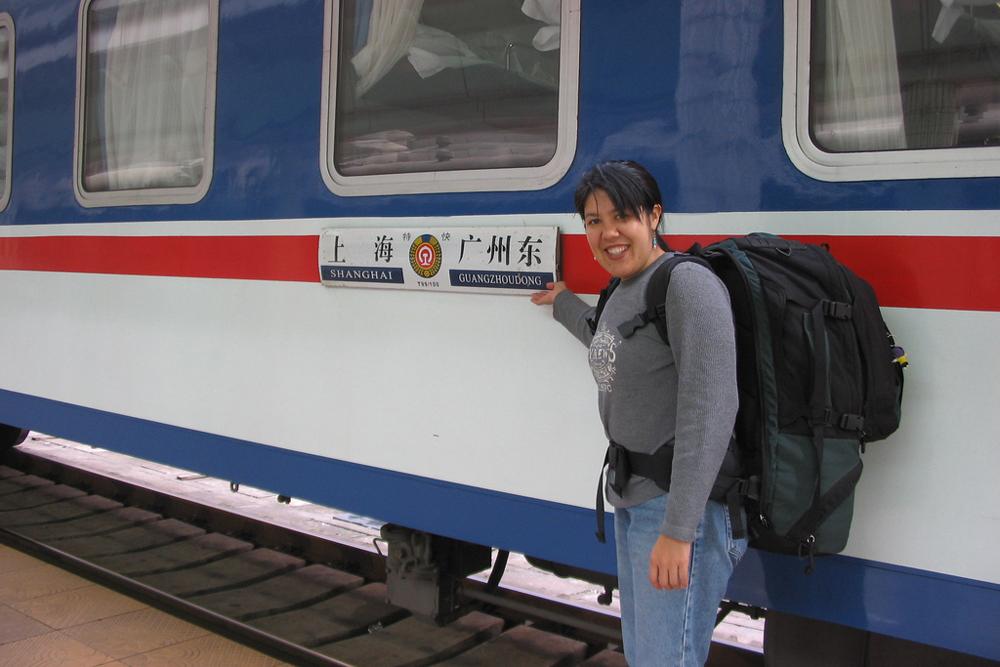
After joining the Peace Corps and then teaching English to engineers in Japan, Jennifer Rocha, MSN, RN, had the skills to walk into any room, in any culture, and find a way to be useful.
Courtesy of Jennifer Rocha
When she capped out on her salary as an ESL teacher, she chose nursing because it was the one credential that would take her anywhere in the world.
She spent a year completing prerequisites for a US nursing school from Japan. Then, mid-backpack through Thailand, the school told her there would be no phone interview. If she wanted in, she had to come in person. She ran to a travel agency, bought a ticket, found a tailor, had a suit made in 24 hours, flew to the United States jet-lagged and overcaffeinated, sat through the interview, went back to Asia to continue backpacking, and got accepted.
She is now a nursing professional development specialist at NYU Langone Orthopedic Hospital. She is a nurse educator, which is what she knew she wanted to be from her first day of orientation. She spent years deliberately accumulating the widest clinical experience she could so that when the job opened, she would be ready. “I have the job I always wanted and the job all my travels prepared me for,” she said.
Although these nurses have all been energized by their professional pivot, the system and their patients equally reap the benefits of their time-tested talents.
“We prioritize the whole person, with wellness and peer-support programs and opportunities to engage in research, publish, and pursue fellowships,” said Dr. Albert. “Our nurse vacancy rate of 3.8 percent is less than half the national benchmark. These results are a product of a culture where nurses feel supported, valued, and empowered to build meaningful, lasting careers.”
For each of these second-career nurses, maintaining the status quo would have meant a lot less friction. They chose to push through the challenges at a health system that values their experience as preparation for a meaningful career.
Media Inquiries
Arielle Sklar
Phone: 646-960-2696
Arielle.Sklar@NYULangone.org