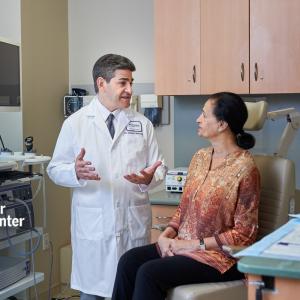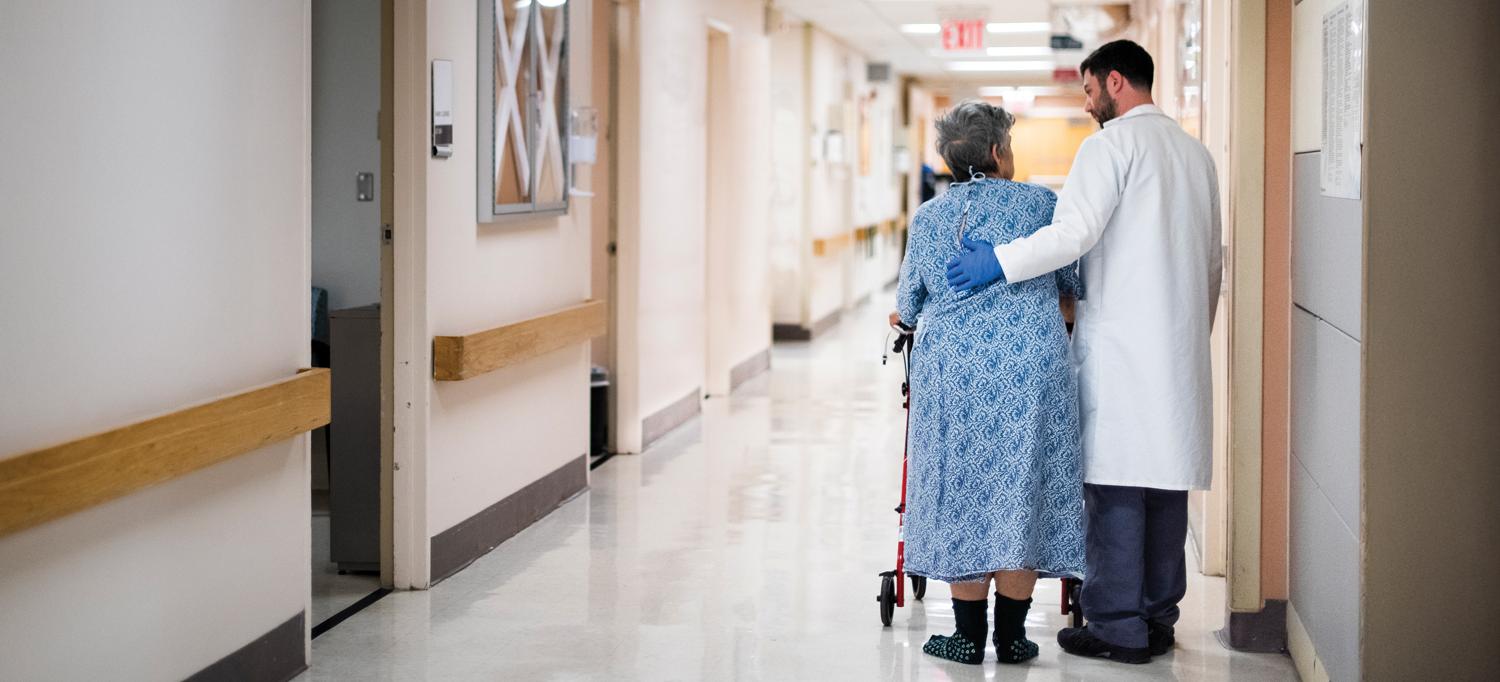
To help ensure that patients receive healthy measures of compassion and connection along with exceptional medical care, NYU Langone’s innovative new program helps future and newly minted doctors understand patients’ feelings and share their concerns.
Credit: Joshua Bright
Cure sometimes, treat often, comfort always.”
With each patient, physicians aspire to fulfill these ideals of Hippocrates, the father of medicine. But empathy doesn’t come naturally or intuitively to every clinician, and it can easily be neglected amid the haste of healthcare.
To help ensure that patients receive healthy measures of compassion and connection along with their exceptional medical care, NYU Langone Health has launched an innovative program to train future and newly minted doctors in the art of understanding patients’ feelings and sharing their concerns. The Center for Empathy in Medicine, an academic unit within NYU Grossman School of Medicine, under the leadership of Jennifer G. Adams, MD, the Frankfort Family Director of the center, establishes the school as a global leader in empathy education, research, and scholarship—and provides a model for medical schools and health systems nationwide.
The center was born out of a partnership between the school’s Institute for Innovations in Medical Education and The Empathy Project, founded in 2013 by Jonathan LaPook, MD, the Mebane Professor of Gastroenterology, to promote empathy in medicine. As part of its mission, leaders in medicine, education, entertainment, and technology produce engaging short films that train healthcare providers to deliver highly compassionate care. One video, Listening, conveys the message that paying careful attention to a patient—not just hearing them—can be key to making an accurate diagnosis. Another, The Elephant in the Waiting Room, shows how empathy can be used to mitigate unintentional bias.
Why is empathy such a priority within our integrated academic health system? Studies show it helps build trust, increases a patient’s engagement in their treatment, boosts compliance, decreases anxiety, and is linked to better outcomes, as well as patient satisfaction. “A clinician who practices empathy avoids a knee-jerk dismissal of a patient’s concerns about, say, a new medication, and instead uses their hesitancy as an opportunity to start a thoughtful discussion,” notes Dr. Adams.
Here, in the words of five distinguished clinicians at NYU Langone, are their perspectives on the transformative power of empathy in patient care.
“When I first meet a patient, that person has never seen me before, yet he or she is willing to put their life in my hands. This is the most vulnerable moment in that person’s life. They are lost, helpless, scared to death. I must treat this person very gently and compassionately. I am not the one assuming the risk. It’s the patient who takes the risk of the surgery. He or she must have courage. I must have conviction and their trust.”
—Chandra Sen, MD, the Bergman Family Professor of Skull Base Surgery; vice chair, Department of Neurosurgery; director, Benign Brain Tumor and Cranial Nerve Disorders Programs
“While proper treatment is critical, good doctoring makes a difference too. I think of my patients as my family, and I would do anything for my family. When I meet with a patient, cancer is usually the last thing we discuss. I try to take their mind off their illness by discussing their joys in life. My goal is to help patients not only live as long as possible, but also with as high a quality of life as possible.”
—Abraham Chachoua, MD, the Antonio Magliocco Jr. Professor of Medicine; director of strategy and innovation, Perlmutter Cancer Center; director, Lung Cancer Center
“Rehabilitation touches everyone because everyone becomes disabled at some point in their life. I enjoy developing long-term relationships with patients. Very few patients give up on themselves. Despite lingering disabilities, with therapy most not only survive but thrive. Their spirit is inspirational. Nothing is more satisfying than seeing a patient with a traumatic brain injury walk out and go on to become a productive citizen.”
—Steven R. Flanagan, MD, the Howard A. Rusk Professor of Rehabilitation Medicine; chair, Department of Physical Medicine and Rehabilitation, Rusk Rehabilitation
“As much as I enjoyed practicing pulmonary and critical care for more than 20 years, I switched specialties to palliative care. My focus shifted from helping patients with lung and other diseases recover to helping gravely ill patients move toward a very different goal: improving their quality of life in the setting of terminal illness, sometimes with days or weeks to live. My education and experience in this specialty strengthened my empathic skills and ultimately helped me get my own mother, who had advanced dementia, into home hospice. That setting provided the support and medications that allowed her to die comfortably in her home, with me and my sister at her side.”
—Joseph Lowy, MD, director, palliative care; liaison, medical ethics, Tisch Hospital
“Hope is the most important factor that gets people through a difficult time. You never take away hope. If you tell someone that they have six months to live, their whole body sets itself to that time period. I’m not talking about false hope. We have to make sure we give hope in the appropriate form and dose. There’s plenty to hope for in modern medicine: hope for a cure, a new treatment, comfort care, or at the end of life, peace.”
—Mark B. Pochapin, MD, the Sholtz-Leeds Professor of Medicine; vice chair of clinical affairs, Department of Medicine; director, Division of Gastroenterology and Hepatology