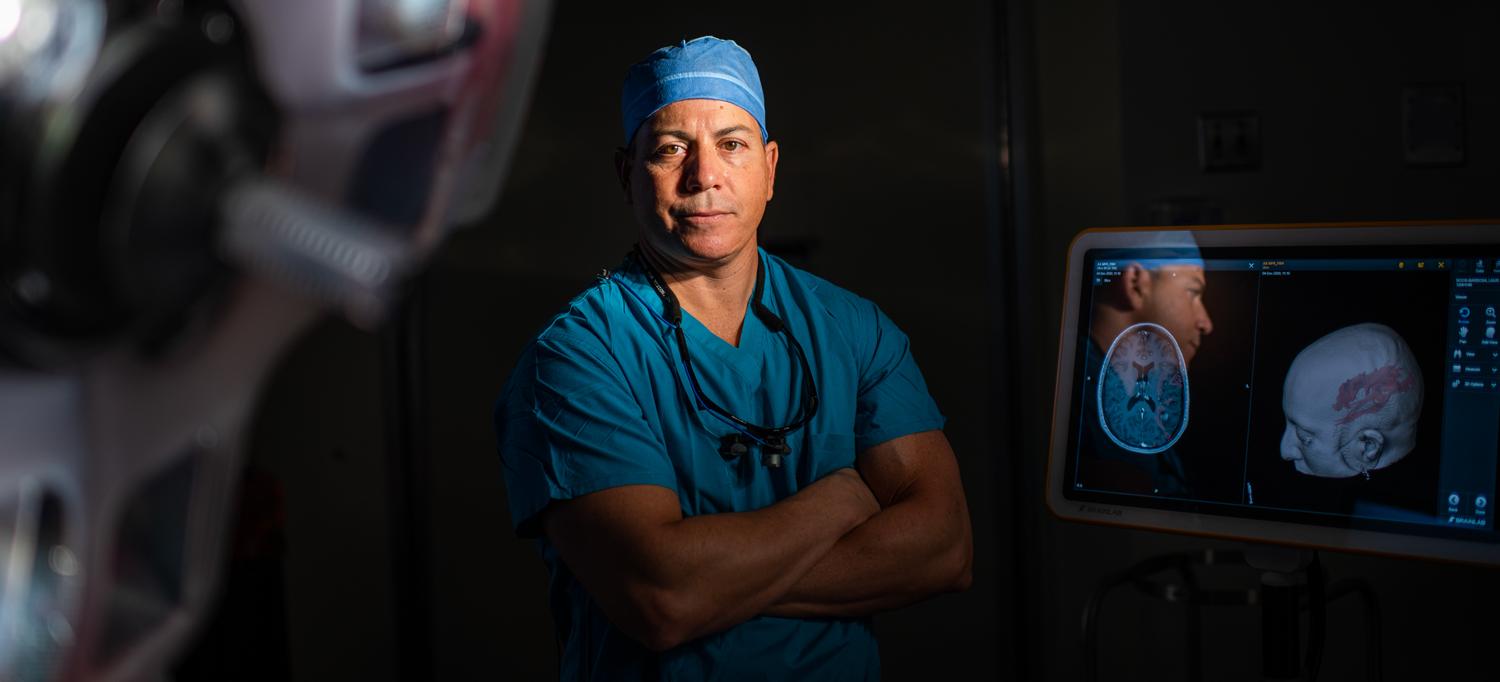
Dr. Lee Tessler, a lifelong nutrition and exercise enthusiast, long ago adopted the same modified Atkins diet he prescribed for the patients who enrolled in his 12-week clinical trial.
Credit: Joshua Bright
Throughout his 25 years as a neurosurgeon, Lee Tessler, MD, says that something has never sat right with him. “We have 40-year-old patients who enjoyed working out at the gym before they were diagnosed with a brain tumor,” explains Dr. Tessler, chief of neurosurgery at NYU Langone Hospital—Long Island. “Then all of a sudden, we tell them, ‘Don’t exert yourself. You just had brain surgery. You’re undergoing treatment.’ But exercise actually counteracts some of the side effects of chemotherapy and radiation therapy, including fatigue, anxiety, and muscle atrophy.”
Dr. Tessler, a lifelong nutrition and exercise enthusiast, notes that as researchers learn more about human physiology, they’re finding that a proper diet and regular exercise boost our ability to fight cancer and feel better by maintaining a healthy immune system. “I wanted to prove that patients who had a brain tumor removed could still do the things they did before surgery,” he says.
Turning up scarce information in published studies, Dr. Tessler decided to investigate the topic himself. In 2022, he embarked on an online master’s degree in exercise physiology at the University of Florida, the country’s top-ranked program in the field. The following year, one of Dr. Tessler’s professors suggested that for a research project, he create a hypothetical clinical trial. Eager to apply his new perspective on biochemistry and physiology to design and test a feasibility study, he responded: “How about if I create a real one?”
Thus was born the idea for the first known clinical trial to test whether diet and exercise can improve the quality of life for patients with a high-grade glioma, the most common primary brain tumor. Gliomas, due to their rapid growth and ability to spread invasively throughout the brain like tentacles, are resistant to even aggressive treatment. With their high recurrence rate, high-grade gliomas result in a median survival rate of only 12 to 14 months.
Dr. Tessler recognized, however, that glioma cells have an inherent vulnerability: they rely on glucose as their primary source of energy. He knew that by drastically lowering glucose availability through a modified diet and structured exercise plan, the body would derive energy primarily from fats and proteins rather than carbohydrates. Unable to adapt to the new fuel source, tumor cells dependent on glucose might die. “There’s pretty good evidence,” says Dr. Tessler, “that a low-carbohydrate diet starves tumor cells but continues to feed normal cells.”
After obtaining clearance from NYU Langone Health’s Institutional Review Board, Dr. Tessler launched a two-year clinical trial in January 2025. The 15 participants who will ultimately enroll—11 have so far—are patients at Perlmutter Cancer Center, a National Cancer Institute–designated Comprehensive Cancer Center. They have had brain surgery and completed their initial radiation therapy, but most are still undergoing some form of treatment.
For a 12-week period, participants follow a strict diet and exercise regimen. A dietician works with each patient to develop food guidelines based on a modified Atkins diet consisting of 60 percent fat, 30 percent protein, and 10 percent carbohydrates, with no calorie restriction but a firm limit of 40 grams of carbohydrates daily. To ensure compliance and confirm that a patient is burning enough fat instead of carbohydrates, a breathalyzer test is performed twice weekly to measure ketones, a byproduct of fat breakdown.
Participants also follow a structured exercise program, working with a personal trainer twice weekly at NYU Langone Ambulatory Care East Meadow and performing individualized exercises at home. The patient’s fitness level is measured by their resting heart rate, how many seconds it takes to complete a 400-meter walk, and strength assessments using weight machines.
One participant who can already attest to the impact of the trial is Lauren Barbosa, who completed her participation on September 24, 2025. A 43-year-old math coach who supports teachers, Barbosa lives in Bayville, Long Island. She has a long relationship with NYU Langone Hospital—Long Island, where both she and her son, Dylan, were born, and where her husband, Leonardo, once worked as a patient transport attendant. In December 2020, Dr. Tessler removed a dime-size tumor from her brain’s left parietal lobe, which controls language and speech. “Dr. Tessler saved my life,” says Barbosa. “He’s an amazing physician, and he has such a good heart.”
Dr. Tessler notes that participants must have enthusiasm for a trial so disciplined and demanding. “Lauren is incredible,” he says. “She has the motivation and desire to get better.”
December 2025 marked five years that Barbosa has been cancer-free. “Dr. Tessler knows I’m super positive,” she says, “and he often tells me, ‘You’re my star now.’ I know how much I’ve overcome, and I’m grateful, so I’m always smiling.”
As a math specialist, Barbosa wasn’t intimidated by the prospect of counting carbs. “I work with data all day long, so I get it,” she says. “I wanted to make sure I did everything right so that Dr. Tessler gets good data for his study.” Barbosa lost weight during the trial and is particularly proud that now she can leg-press 274 pounds instead of her initial 190. She feels so much more energetic these days that she’s committed to maintaining the same diet and exercise regimen long-term. Dr. Tessler reports that every single participant thus far has expressed the same desire.
“It’s very important for these patients to feel that they have control over something,” notes Dr. Tessler. “My goal is to prove that people undergoing treatment for a brain tumor can safely participate in physical activities and that by doing so, their quality of life will improve. I hope this one day becomes the new standard of care for every neuro-oncologist and neurosurgeon.”