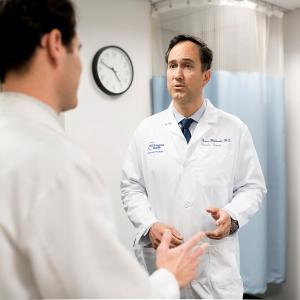
Kathleen Pastori walks the halls at Tisch Hospital with Karan Garg, MD, whose innovative endovascular procedure saved her foot from amputation.
Credit: Mateo Salcedo
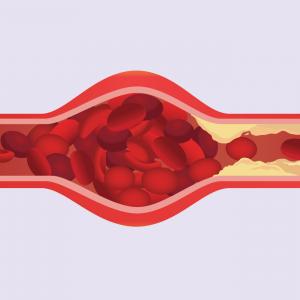
In November 2024, Kathleen Pastori developed a sore on her left heel that wouldn’t go away. Pastori, then 75, had been diagnosed with peripheral artery disease, a common circulatory problem afflicting people with diabetes. A narrowing of arteries from plaque buildup reduces blood flow to the legs, often leading to painful foot ulcers. The disease can cause life-threatening infection and tissue death, or gangrene, a condition that may require amputation.
Pastori, a grandmother of seven who lives in Bay Ridge, Brooklyn, had endured a gangrenous ulcer in her right foot several years earlier. Her podiatrist at NYU Langone Brooklyn Podiatry Associates—77th Street, Jeffrey V. Lucido, DPM, treated it successfully with a technique called debridement, cleaning out necrotic tissue and applying specialized dressings.
This time, though, the problem was more extreme. Besides the ulcer, there were patches of purplish skin—a sign of advancing gangrene—around the fourth and fifth toes. Tests showed she had developed the most severe form of peripheral artery disease, known as chronic limb-threatening ischemia, in her left leg. The condition results in more than 150,000 amputations each year. Leg and foot amputations are associated with high mortality rates, along with complications such as phantom limb pain. They can also curtail people’s ability to live independently, an outcome Pastori had witnessed in several of her friends.
Determined not to lose her foot, Pastori consulted a vascular surgeon at another hospital. He explained that the gold-standard therapy for her condition is arterial bypass surgery, a procedure that reroutes blood flow by connecting a healthy artery above the blockage to one below it. However, the arteries in Pastori’s lower leg were too badly damaged to operate on. “He told me amputation was my only option,” recalls Pastori. “I said, ‘That’s not happening!’”
For a second opinion, Pastori turned to Dr. Lucido, whose ties throughout the NYU Langone Health network ensure that Brooklyn-based patients have access to a full range of specialized foot and leg care. He suggested deep vein arterialization, a therapy that had only recently been approved by the Food and Drug Administration. In this approach, surgeons connect an artery in the upper calf to a nearby vein, then modify the vein to send blood to the foot instead of returning it to the heart.
When Pastori expressed interest, Dr. Lucido referred her to Karan Garg, MD, co-director of the Limb Salvage and Restoration Center at NYU Langone. Dr. Garg was among the first vascular surgeons in the metropolitan area to offer the technique, trademarked as LimFlow. Dr. Garg viewed Pastori as a strong candidate: She had always been active, taking daily walks around her neighborhood until her foot troubles surfaced. She also had an excellent track record of complying with doctors’ orders, including quitting cigarettes following her earlier bout of gangrene.
“In clinical trials, LimFlow has been shown to enable two out of three patients to avoid amputation, and our results have been even better,” says Dr. Garg. “Still, during recovery it’s crucial to keep up with wound care and medications. I tell all my patients, ‘When I say jump, you should say, ‘How high?’”
Pastori was won over by the surgeon’s animated description of the procedure. “Dr. Garg is like the smartest kid in your high school class, and he clearly loves his work,” she says. “He’s so enthusiastic that you get caught up in the wave of his excitement.”
On December 18, 2024, she was wheeled into an operating room at the Helen L. and Martin S. Kimmel Pavilion in Manhattan for the 5.5-hour procedure. Dr. Garg inserted one catheter through an artery in her groin and another through a vein in the sole of her foot. Guided by real-time X-ray imaging, he carefully advanced the catheters until they met below Pastori’s knee. He used a needle to create an opening between the artery and the vein and ran a guide wire through it. Then he removed valves in the vein so blood could flow in the desired direction. Next, he inflated a tiny balloon to open up the vein, a procedure called angioplasty. Finally, he positioned two covered stents, one to create a channel between the vein and the artery and another to prevent blood from escaping into the vein’s branches.
Pastori went home two days later. A few weeks after that, she missed some doses of her blood thinner, and her newly opened vessel shut down. A second angioplasty by Dr. Garg removed the blockage. Since then, she has rigorously followed the prescribed regimen, including physical therapy.
Although LimFlow spares most patients from below-the-knee amputation, some people ultimately lose toes. By the spring of 2025, it became clear that Pastori’s fifth toe could not be saved, and Dr. Lucido removed it. Fortunately, the effects on her quality of life have been minimal. “To be honest,” she says, “I don’t miss it.”
Pastori’s foot is now fully healed. Aided by a cane, she has resumed her daily strolls, sometimes accompanied by one or more of her grandchildren. She’s grateful to Dr. Lucido and Dr. Garg, who made her renewed mobility possible. “I love them both,” she says. “They’ve proved to me that miracles do happen.”