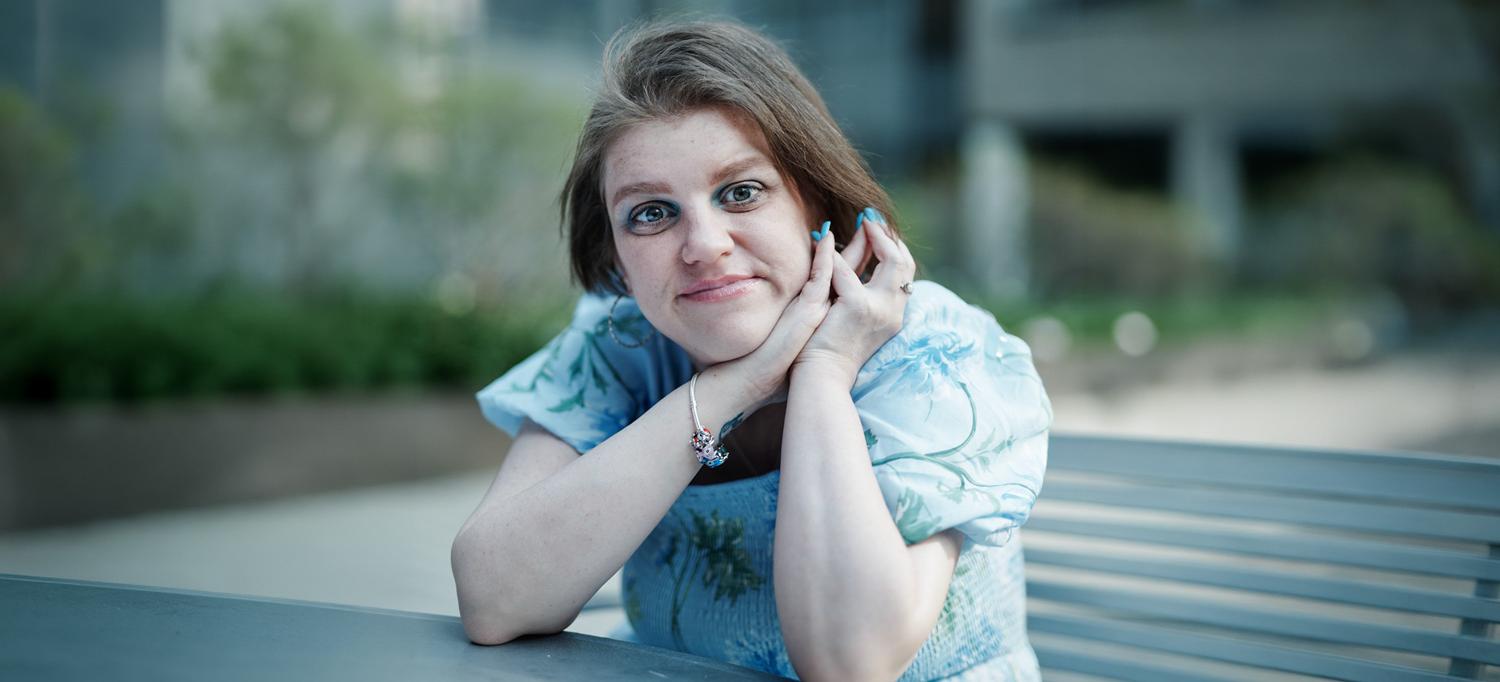
Molly Eschenbach received a heart transplant at NYU Langone Health last year. Now she is in good health and engaged to be married.
Credit: Tony Luong
Molly Eschenbach had a rough start in life. Born with severe heart defects, she underwent cardiac surgery when she was just a few days old. After another heart procedure seven months later, she developed a rare condition called endocarditis, an infection of the heart’s inner lining. A powerful antibiotic saved her life but destroyed her hearing. She suffered developmental delays as well, likely due to oxygen deprivation during the second surgery.
With tireless support from her parents, Suzanne and Stephen, Molly thrived nonetheless, learning to communicate in sign language and attending high school at the American School for the Deaf in West Hartford, Connecticut. At 21, she moved into a supervised group home for hearing-impaired adults in Paterson, New Jersey. She enjoyed biking, cooking, drawing, and frequent visits from family members. Three years ago, at age 30, she found love with a fellow resident, Jeremiah Ortega, and the pair became inseparable. “It was a really positive and affirming environment,” Stephen says.
But in February 2025, Molly’s health troubles returned with a vengeance. A new bout of endocarditis led to a massive heart attack. She was admitted to a medical center in New York City, where doctors determined she would need a heart transplant to survive. However, they declined to place her on the waitlist, citing the challenges of aftercare for patients in group homes. Molly was transferred to another hospital, but transplant surgeons there concluded that the complexity of her case exceeded their capabilities. A third hospital declined even to evaluate her.
Finally, in April, one of Suzanne’s physician colleagues suggested she contact Alex Reyentovich, MD, director of the Heart Failure Program and medical director of the Heart Transplant Program at NYU Langone Health. “We’ve always fought for her,” Suzanne told him, “and we’re not going to let her die.”
Dr. Reyentovich reached out to Dan G. Halpern, MD, medical director of the Adult Congenital Heart Disease Program, who looped in T.K. Susheel Kumar, MD, director of the Pediatric Heart Failure and Transplant Program (who also provides surgical treatment for adults with congenital heart disease), and Nader Moazami, MD, chief of the Division of Heart and Lung Transplantation and Mechanical Circulatory Support. “Molly’s story, and her parents’ motivation, won us over,” says Dr. Reyentovich.
Their decision to proceed was informed by an extraordinary track record. NYU Langone is the No. 1 health system in the country for cardiology and heart and vascular surgery, according to U.S. News and World Report’s Best Hospitals rankings. The Adult Congenital Heart Disease Program is designated as a Comprehensive Care Center, the first in New York State to receive the distinction. The Heart Transplant Program, part of the NYU Langone Transplant Institute, has the shortest wait times in New York State and among the highest one-year survival rates in the Northeast, according to the Scientific Registry of Transplant Recipients. “About 20 percent of NYU Langone’s heart transplant patients have been rejected by other centers due to medical complexity,” notes Dr. Reyentovich. “We routinely take on the most complicated patients in the region.”
Among those complex cases are adults with congenital heart disease, whose abnormal cardiovascular anatomy, often coupled with other health challenges, requires specialized expertise and multidisciplinary coordination. “We’re used to dealing with scarring from past surgeries, higher risk of bleeding, different reactions to medications,” explains Dr. Halpern. “Many programs aren’t equipped to handle these cases.”
By the time Molly was at NYU Langone, she’d gone into cardiac arrest twice. A third episode occurred while she was being admitted, and her kidneys were starting to fail due to insufficient blood flow. Yet a battery of tests confirmed she was a viable candidate for transplantation, with high potential for a positive long-term outcome. To help her survive until a suitable donor organ became available, her care team—including Adam Small, MD, associate medical director of the Adult Congenital Heart Disease Program—realized that strong psychosocial support was crucial. Stephen, a data scientist who works remotely, was given a bed so he could stay by his daughter’s side around the clock. Suzanne, a psychiatrist, relieved her husband whenever possible. Jeremiah also visited, and the couple had video calls frequently.
Meanwhile, cardiac social worker Olivia Gregory, LMSW, dropped by every day, bringing the patient’s preferred coloring pages (featuring characters from Lilo & Stitch) and her beloved iced Starbucks drinks. Gregory provided both companionship—drawing and watching videos with Molly—and counsel. “Molly desperately wanted to go home and get back to her life,” she says. “I helped her understand why she was in the hospital and helped make her stay as comfortable as possible.”
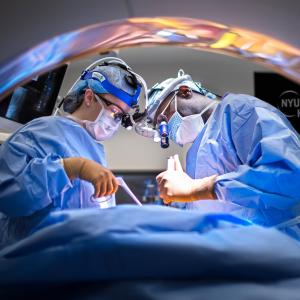
The severity of Molly’s illness put her at the top of the waitlist, and an organ became available within a month. On May 27, 2025, she was wheeled into an operating room at the Helen L. and Martin S. Kimmel Pavilion, where Dr. Kumar, assisted by Dr. Moazami, led the 13-hour surgery. After placing her on a heart-lung machine, the two surgeons meticulously removed her old heart, adjusted the surrounding tissue and blood vessels, and fitted her new one in place.
Although the procedure was successful, Molly experienced several common postoperative complications, including a mild rejection episode, kidney problems that briefly required dialysis, and fluid buildup around her lungs. She endured them stoically. “‘Tough’ is my favorite word,” she says with a proud smile. In July, she was moved to an inpatient facility at Rusk Rehabilitation, where she spent a month undergoing physical therapy, supervised by physiatrist Jeffrey M. Cohen, MD. Finally, on August 21, she returned to the group home.
A year later, Molly remains in good health, thanks in part to antirejection and other medications sent by NYU Langone’s nurse practitioners. Staffers at the residence oversee her regimen and ensure she attends follow-up appointments.
Now that her ordeal is behind her, Molly is happily looking toward the future. Jeremiah recently asked her to marry him, and she accepted. Her parents are over the moon, not just because they adore their future son-in-law. “NYU Langone could see that Molly wanted to live, and they were all in,” says Stephen. “They came through in every way.”