According to the study findings, early intervention though programs can help children learn in school, even years after the programs have ended.
Credit:Getty Images / Alan Mazzocco
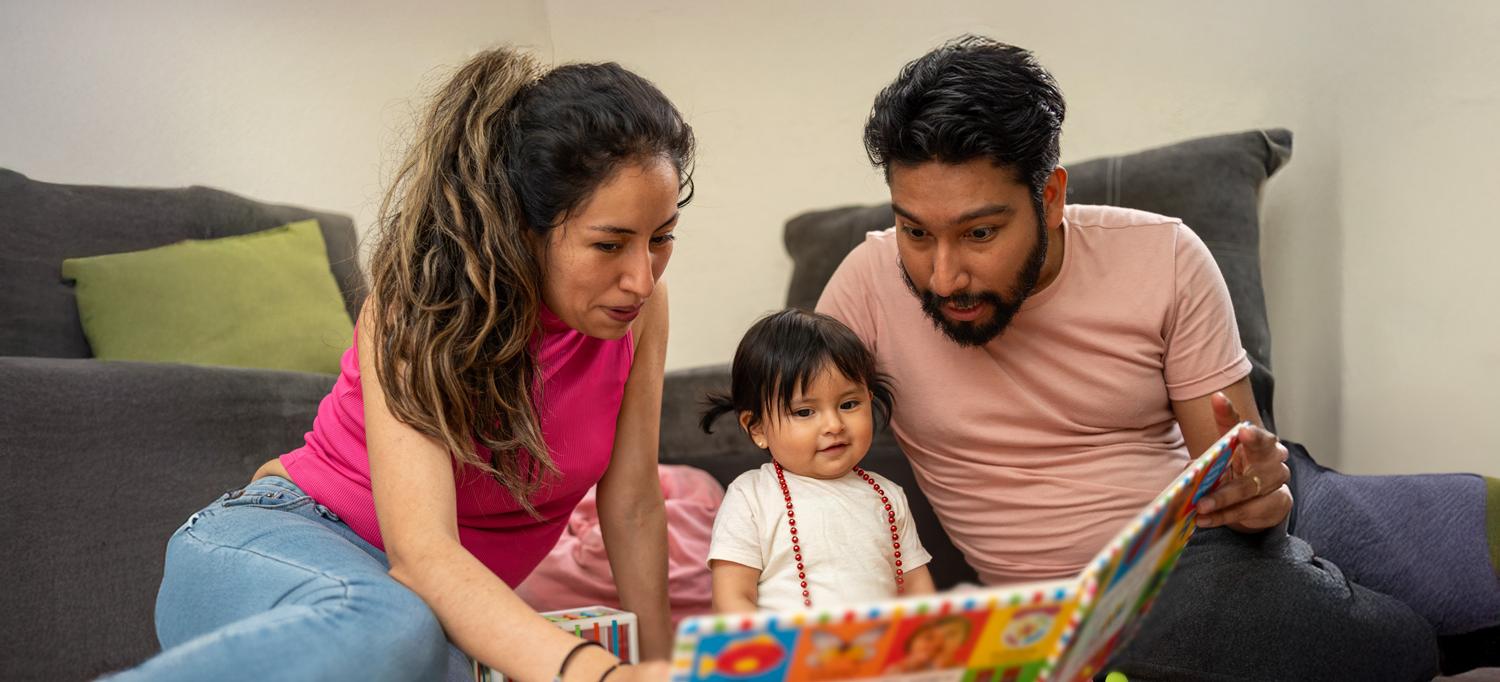
Guiding parents to have pretend play and read aloud with their babies increased parental support of their children’s cognitive development and academic skills by the time they turned 6—especially for families facing poverty.
This is the finding of a new study, led by researchers at NYU Grossman School of Medicine, New York University, and the University of Pittsburgh, which evaluated the effects of a comprehensive model to support parenting.
Called Smart Beginnings (SB), the approach combines two methods. PlayReadVIP (formerly the Video Interaction Project) takes place at pediatric checkups from birth to age 3. As part of the program, parents watch themselves on video reading or playing together with their child with a new book or toy to foster skills that support development. The second approach, Family Check-Up, happens in the home, using clinical family management strategies to address difficult child behaviors and other challenges, especially among families facing adversity, such as maternal depression.
For the study, 403 mothers of newborns enrolled They all had low incomes and lived in either New York City or Pittsburgh. Half were randomly assigned to receive Smart Beginnings, while the rest received standard pediatric primary care.
Analysis of the program, published in Pediatrics online December 15, showed that the SB comprehensive model and its video-recorded interactions of parents and children playing at age 2 led to increases in cognitive stimulation, and that this in turn resulted in better academic skills when children reached the first grade.
These findings expand on earlier work showing similar findings at age 4, before children had started elementary school.
“Our findings demonstrate that early preventive intervention through Smart Beginnings can result in long-standing impacts in elementary school, even three years after completion of the program,” said study lead investigator Elizabeth B. Miller, PhD, an assistant professor in the Department of Population Health at NYU Langone Health. “Importantly, the SB model provides these services at a far lower cost than other approaches with similar goals.”
According to Dr. Miller, the results of this study are critically important for early childhood policy. The findings represent one of the first demonstrations of feasibility and impact for tiered approaches to achieve population-level impacts, providing strong evidence to support recent recommendations by the American Academy of Pediatrics and the National Academies of Sciences, Engineering, and Medicine. Findings additionally provide strong support for ongoing implementation and scaling of SB’s composite programs, PlayReadVIP and Family Check-Up.
Funding for the study was provided by the Eunice Kennedy Shriver National Institute of Child Health and Human Development of the National Institutes of Health, grant R01HD076390.
Besides Dr. Miller, other NYU study investigators are Principal Investigators Pamela A. Morris-Perez and Alan L. Mendelsohn, MD, together with Caitlin F. Canfield, PhD; Ashleigh I. Aviles, PhD; and Erin M. Roby, PhD. University of Pittsburgh in Pennsylvania investigators are Principal Investigator Daniel S. Shaw, PhD, together with Leah J. Hunter, PhD.
About NYU Langone Health
NYU Langone Health is a fully integrated health system that consistently achieves the best patient outcomes through a rigorous focus on quality that has resulted in some of the lowest mortality rates in the nation. Vizient Inc. has ranked NYU Langone No. 1 out of 118 comprehensive academic medical centers across the nation for four years in a row, and U.S. News & World Report recently ranked four of its clinical specialties number one in the nation. NYU Langone offers a comprehensive range of medical services with one high standard of care across seven inpatient locations, its Perlmutter Cancer Center, and more than 320 outpatient locations in the New York area and Florida. The system also includes two tuition-free medical schools, in Manhattan and on Long Island, and a vast research enterprise.
Media Inquiries
Sasha Walek
Phone: 917-838-9607
Sasha.Walek@NYULangone.org