The 100-odd members of the class come from 26 states, speak a total of 14 languages, and have a median GPA of 3.98 and a median MCAT score in the 99th percentile.
Credit: Juliana Thomas
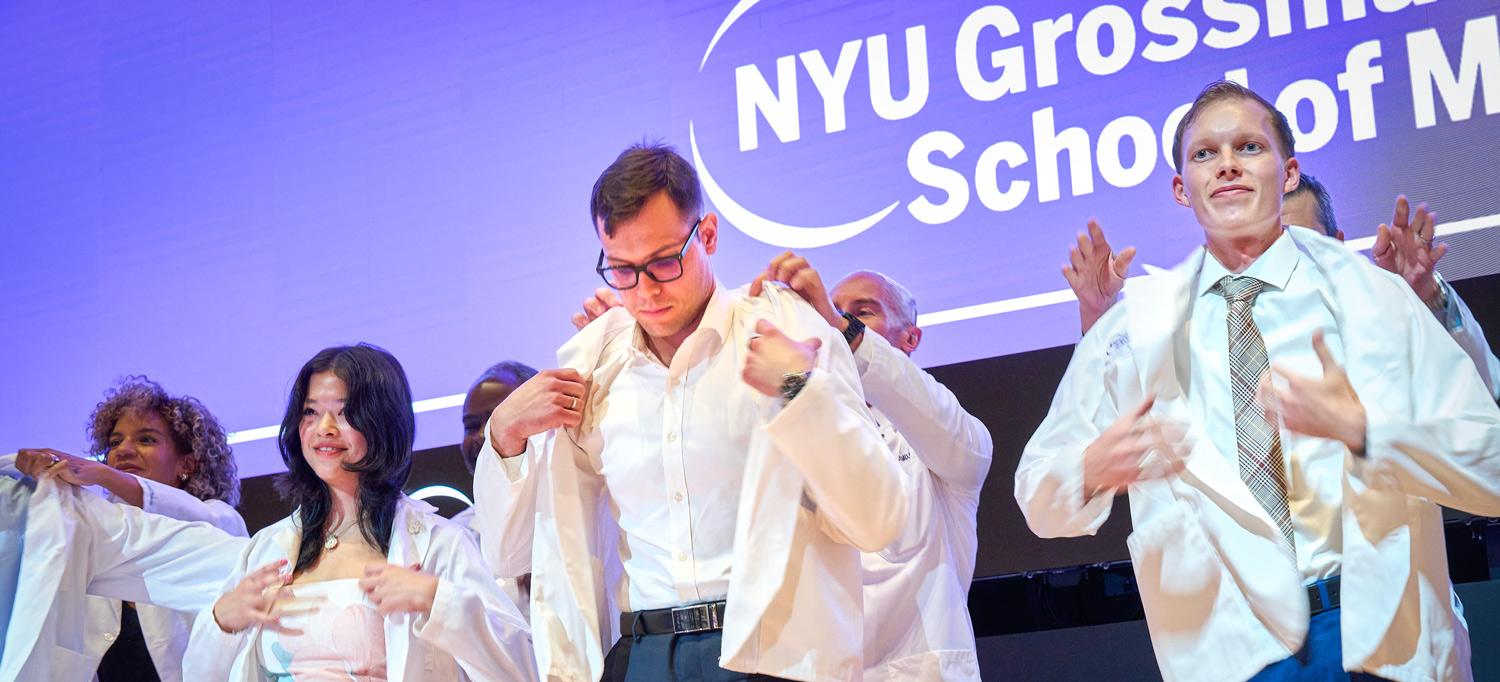
On the afternoon of Friday, July 10, inside a packed Murphy Auditorium, NYU Grossman School of Medicine’s class of 2029 donned their white coats for the first time.
The White Coat Ceremony is a rite of passage that welcomes newly matriculated medical students into the profession, and this year some 450 family members, faculty, mentors, deans, and executive leaders looked on as the incoming class of approximately 100 medical students crossed the stage, one by one, into NYU Grossman’s pioneering three-year, tuition-free program.
“Today, you are not simply putting on a white coat—you are stepping into your calling,” Alec C. Kimmelman, MD, PhD, dean of the medical school and CEO of NYU Langone, told the class. “The white coat is more than a symbol; it is a promise. It reflects the trust that patients and families will place in you, the integrity and empathy that will guide you, and the NYU Grossman School of Medicine community that will support you.”
For one member of the class, that promise began more than a decade ago and 4,700 miles away.
From Immigrant to Army Medic to Medical Student
Arm in arm with his best friend at a funeral in Moldova, 14-year-old Nikita Chernetskii made a promise. The man they were burying was his best friend’s father, a compassionate psychiatrist who had stepped in as a father figure after Chernetskii’s own father died before he was old enough to memorize his face. Standing at the grave together, the boys vowed to honor their father by becoming doctors.
Chernetskii carried that promise through his teenage years, and after graduating high school, he began to apply to medical schools in Moldova, where students enter medicine straight from high school. Unbeknownst to him, his stepfather had entered the family in a green card lottery to immigrate to the United States for five years running, and right after his graduation, they won. Chernetskii had to immediately leave the only country he called home to take advantage of this win, heading to America for the first time.
There was no plan waiting for Chernetskii when he arrived in Queens. Within days, he was working, hauling trash out of buildings and stocking a grocery warehouse, worlds away from any path that could lead to medical school. Back home, his friends went on to universities and grew apart from him. He began to lose hope.
“My dream was dying in front of me, and I started to feel a lot of despair,” said Chernetskii.
About a year into his new life in America, a friend from work mentioned he was going to see a military recruiter. Chernetskii assumed his new-to-the country English skills would disqualify him. Then one morning he decided to find out for himself. “I went up to the mirror in my bathroom, I rehearsed two or three phrases, and I went to see a recruiter,” he said. “In two weeks I was already marching in Fort Benning, Georgia.”
He served four years as a combat medic. His role gave him something to hold on to. “I’m here for the people,” he told himself. “I get the privilege of helping people.”
When his service ended, the road to medicine was still far from clear. Chernetskii had never taken the SAT, never sat in an American classroom, never written a college essay.
While studying at Hunter College, Chernetskii was accepted into NYU Langone’s Scientific and Technical Education Pathway Programs for Students (STEPPS), a pipeline that pairs aspiring physicians with faculty based on their interests. One of his interests was trauma surgery, and STEPPS connected him to the trauma service at NYC Health + Hospitals/Bellevue and to Michael J. Klein, MD, who brought him close to the operating table.
“Dr. Klein showed me that NYU has the best physicians and residency program for general surgery, especially for trauma. I got to see the doctors, the students, the residents of NYU Langone being exceptional,” he said. What surprised him most was the culture. “What I saw in the surgery department was unlike any other place: While [it was] high pace and demanding, everyone was treated as a human being first, from chief to intern,” said Chernetskii.
From World School to Medical School
Maja Sato’s Japanese father and American mother had each lived years abroad. “Growing up in that multicultural household, I was always really curious about the world outside of where I lived,” she said. “I wanted to really immerse myself and live in a place long term.”
The Peace Corps had been her goal since before she arrived at Fordham University. After graduating, she was posted to Ecuador and stayed three years. “We went to soccer teams, we went to open-air markets where the kids’ parents are vendors, helping these kids develop good life skills that would help them grow into healthier and happier adults.” One of her projects was supporting a group for families of premature infants. Sato spent her third year in Quito training incoming volunteers.
“As a volunteer I was confronted with a feeling of wanting to do more, but not being able to, because I didn’t have that training yet. That was when I knew I wanted to go to medical school.”
The support group had been founded by a local mother whose premature baby arrived in a health system unequipped to care for one. “She educated herself, she advocated to her providers, and she worked so hard to change the education in that community around premature babies,” Sato said. “If something isn’t already there, you can be somebody who creates it.”
She wants to go into obstetrics-gynecology and women’s health, combined with global health work, bringing resources and education to underserved communities.
From Training in the Gymnasium to Training in the Clinic
Mark Berlaga of Palo Alto, California, learned his defining lesson four hours a day, every day, on the rings of Stanford University’s Division I gymnastics team. “We had a saying at Stanford,” he said. “There are no student-athletes. It’s all athlete-student.”
Balancing that training load with premed coursework meant starting every assignment the day it was handed out and skipping senior formal because NCAA championships were the following week. It also meant learning to put something larger than himself first. “It teaches you to be there for your team, even if it means you have to sacrifice some things,” he said. “I think that’s important in medicine as well. It’s not an individual sport.”
The sport’s toll, which included a spinal fracture and a torn shoulder, introduced him to the doctors, physical therapists, and athletic trainers who got him back to competing. It also planted the idea that he could be that person for someone else. The idea crystallized during an EMT ride-along, when a paramedic handed him a bag valve mask as a coding patient arrived. “He said, one breath every six seconds, go,” remembers Berlaga. “I got to be part of that medical team helping the patient survive. I knew I wanted to be part of the team that gets people back to doing what they love.”
From Keeping Organs Alive to Chasing Transplant’s Next Frontier
Avery Fortier of Lexington, Massachusetts, found her way to NYU Grossman by following the science, sometimes literally. As an undergraduate at Vanderbilt, she had worked in a transplant lab and volunteered in the emergency department, where watching patients interact with their doctors made everything click. When she graduated, she knew exactly what she wanted: She typed “transplant lab New York” into Google and applied for a job that had already been filled. The lab was so impressed they created a new position for her.
For two years she worked as a perfusionist, preparing donor livers for transplant by connecting them to a machine that circulates human blood through the organ. “It’s basically mimicking a human body,” she said. “It allows us to use riskier livers for transplant with better confidence that they’ll perform well in the patient.”
When a transplant patient Fortier had worked with died, she became a hospice volunteer to honor his legacy. While volunteering in the hospice Fortier got to use her decade of studying Mandarin to read the news aloud “to a 103-year-old Chinese patient, who was blind and nearly deaf and could not do so on his own.” Fortier found this work especially meaningful because the transplant patient was unable to use sign language. “It’s hard enough to be sick, to not be easily understood by your doctors is impossible,” she said. Fortier hopes to continue to work to bridge communication gaps in the clinic as she becomes a physician.
For Fortier, NYU Grossman was her dream’s next chapter. “The research going on at the school and the way it’s been translated to the clinic aligns so well with my interests,” she said, pointing to the xenotransplantation work of Robert Montgomery, MD, DPhil, and the face, hand and eye transplant programs led by Eduardo D. Rodriguez, MD. “They’re applying the technologies I’ve been studying and working with.”
Answering the Call
Every member of this class remembers exactly where they were when they got their congratulatory call from Rafael Rivera, MD, MBA, NYU Grossman’s senior associate dean for admissions and financial aid.
Fortier was at her desk at 4:30 on a Friday afternoon, in a bad mood after a failed experiment. A New York number earlier that day had turned out to be Duane Reade, so when another one appeared, she answered warily. It was Dean Rivera. She made him repeat the news and asked if he was sure it wasn’t a prank.
Chernetskii was at Bellevue with Dr. Klein when an unknown number lit up his phone. He looked at his mentor and said, “That’s it.” He got to share the moment with the man who showed him the way, and then immediately called his wife.
Sato was in the car with her mom and sister, home on Peace Corps leave, scrambling to disconnect her phone from the Bluetooth. By the time they reached the gym, her mother was telling everyone in the building.
Berlaga texted his family group chat, then his roommates. “It was probably one of the best days of my life,” he said. “Second to maybe winning the national championship.”
The Future of Medicine Listens
The students’ answers converge when asked how they hope their future patients will describe them. Fortier hopes to be known as an excellent doctor who cares about her patients’ experience and outcomes. Sato wants to be a provider who listens well, advocates fiercely, and earns trust. Berlaga hopes for compassionate, team oriented, and driven. Chernetskii wants what his fellow soldiers once said of him: “That I listened to them. That I talked to them.”
They all reference free tuition as fuel for their ability to focus.
“There’s no pressure to pick something higher paying just to pay off debt,” Berlaga said. For Chernitskii, the impact reaches even further. “My wife and I want to start a family, and not having 300,000 to 500,000 dollars of debt lets us start thinking about kids much earlier. Being a present doctor, a happy doctor, goes far beyond you. It goes to your patients and their families.”
The four of them were selected, along with their classmates, from 8,185 applicants. The class comes from 26 states, collectively speaks 14 languages, and posted a median GPA of 3.98 and a median MCAT score in the 99th percentile.
From the podium, Dean Kimmelman offered the class one last piece of advice: “Each of you has a reason you are here. Maybe it began with a patient you loved, a family experience, a teacher, a discovery, or a moment when you realized that medicine was the place where your talents and your purpose could meet. Hold on to that why. It will not make every hard day easy. But it can steady you when the work becomes difficult.”
Media Inquiries
Arielle Sklar
Phone: 646-960-2696
Arielle.Sklar@NYULangone.org