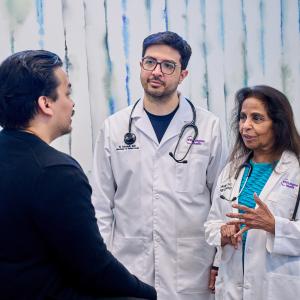
New York Jets rookie tight end Kenyon Sadiq, flanked by Michele DeDea, associate director of Cancer Center Partnerships at American Cancer Society, and Anil Vachani, MD, director of the Lung Cancer Screening Program at Perlmutter Cancer Center, visited NYU Langone Health to raise awareness about the importance of cancer screening and early detection.
NYU Langone
New York Jets rookie tight end Kenyon Sadiq visited NYU Langone Health to raise awareness about the importance of cancer screening and early detection, joining physicians, staff, and a patient from NYU Langone’s Perlmutter Cancer Center to highlight efforts to expand access to lifesaving screenings.
The visit was part of the NFL’s Crucial Catch initiative, in partnership with the American Cancer Society (ACS). Through an ACS CHANGE Grant funded by the NFL, Perlmutter Cancer Center is expanding access to lung and colorectal cancer screenings by identifying patients eligible for both tests and helping coordinate same-day screening appointments. By allowing patients to complete both screenings in one visit, the program aims to simplify the process and help more people get the preventative care they need.
For Sadiq, the opportunity to advocate for early detection is personal. His grandmother, who played an important role in his upbringing, died earlier this year after undergoing treatment for stage four breast cancer.
“Crucial Catch and NYU Langone do a great job of bridging pathways from different communities and bringing awareness all throughout people’s lives,” Sadiq said. “My message for people would just be, you can never be too busy to try and help your life or your family's life. It's about taking that extra step, however long it takes out of your day, to go get a screening and really save your life and help protect your family as well.”
Expanding Access to Cancer Screening
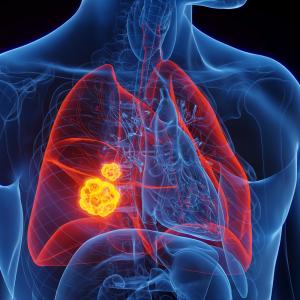
Lung cancer is the leading cause of cancer death in the United States. Although it is often diagnosed at an advanced stage, screening can detect the disease earlier, when treatment is more likely to be successful. Early lung cancer rarely causes symptoms, making screening particularly important for people at increased risk.
“Cancer screening is, on the one hand, one of the simplest things available to us. In most cases, it's a relatively straightforward preventive test,” said Anil Vachani, MD, director of the Lung Cancer Screening Program at Perlmutter Cancer Center. “But on the other hand, it's perhaps one of the most complex because getting awareness out to the population, those who are eligible, those who are at risk, is very hard to do when people feel well and don't feel sick.”
The U.S. Preventive Services Task Force recommends annual lung cancer screening with a low-dose computed tomography (CT) scan for adults ages 50 to 80 who have a smoking history of at least 20 pack-years and currently smoke or quit within the past 15 years. A pack-year is calculated by multiplying the number of packs of cigarettes smoked per day by the number of years a person smoked.
The difference early detection can make is significant. Among people with non-small cell lung cancer, the most common type of lung cancer, 67 percent are alive five years after diagnosis when the disease is found at an early stage, compared with 12 percent when it has spread to other parts of the body.
“We know that individuals who are eligible for cancer screening, particularly colon cancer screening and lung cancer screening, are not getting screened at nearly the rates that we would like to see,” said Dr. Vachani.
Through the CHANGE Grant, NYU Langone is working to close that gap by identifying patients who are eligible for both screenings and connecting them with the resources they need to complete them both in a single visit.
“We've partnered with the American Cancer Society to identify individuals who are eligible for both cancer screening tests as a way to pair an opportunity for education with an opportunity for outreach,” Dr. Vachani said.
One Patient’s Crucial Lung Cancer Catch
For Earl Anderson, age 56, one of Dr. Vachani’s patients, lung cancer screening provided a crucial early detection. His mother was diagnosed with stage four lung cancer in 2017 and died the following year. After her diagnosis, Anderson received a call from NYU Langone about its lung cancer screening program and began going in for annual scans.
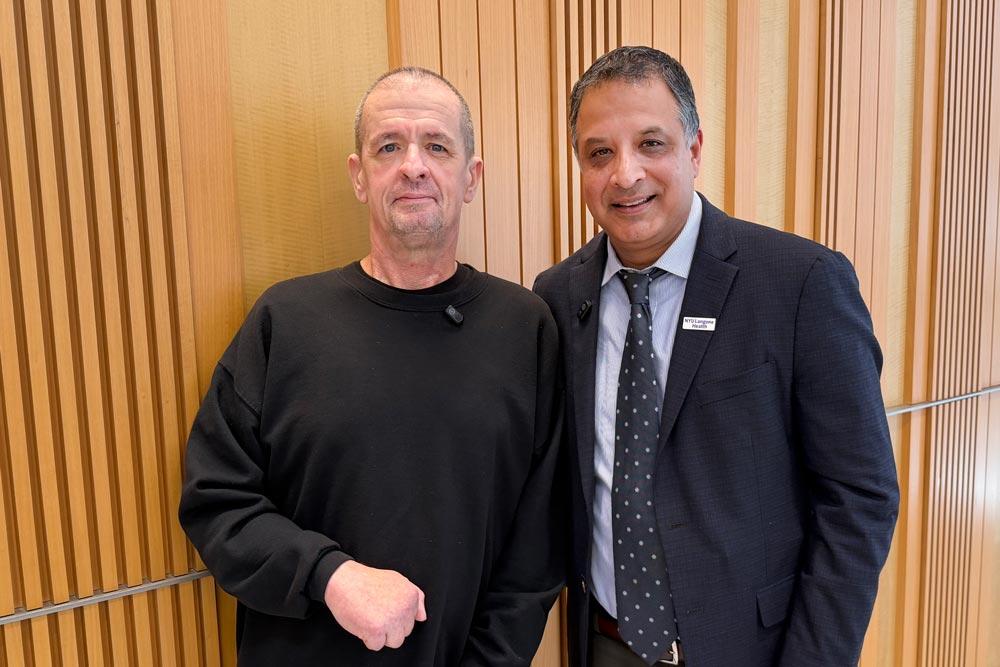
Earl Anderson and Dr. Anil Vachani
NYU Langone Health
For several years, his results showed no signs of cancer. Then, in 2025, a routine scan detected a tumor, and additional testing confirmed his diagnosis of stage one lung cancer.
“Getting a cancer diagnosis is scary,” Anderson said. “Dr. Vachani and his team reassured me and helped me determine the best treatment.”
Anderson underwent surgery to remove his tumor with Amie J. Kent, MD, a cardiothoracic surgeon at NYU Langone Health, and is now receiving immunotherapy at Perlmutter Cancer Center to prevent the cancer from coming back.
Today, Anderson said he feels great and hopes his experience encourages others who are eligible for screening to make the appointment rather than put it off.
“When it was time for my screening, I was thinking about putting it off, because for a couple of years I was okay,” he said. “But if you have the opportunity to do it, do it.”
Dr. Vachani said Anderson's experience demonstrates the potentially lifesaving impact of annual screening.
“If you are eligible and if you have the risk factors, don't delay it,” Dr. Vachani said. “Delaying cancer screening only puts patients at greater risk for having an advanced cancer diagnosis. We want to be able to diagnose people at the earliest, most treatable stage.”
Media Contacts
Lacy Scarmana
332-215-3613
Lacy.Scarmana@NYULangone.org
Casey Nicholl
646-983-4920
Casey.Nicholl@NYULangone.org