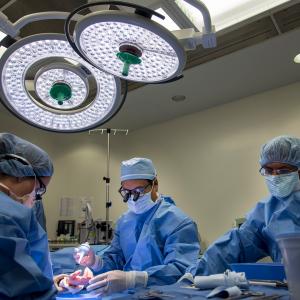
Hand and wrist surgeon Nader Paksima, DO, MPH, is the first surgeon in Manhattan to offer ultrasound-guided carpal tunnel release, a technique that affords a smaller incision and a quicker recovery than other methods.
Credit: Joe Carrotta
At 83, an age when most Americans are well into their retirement, John Diczok still loves working as a financial adviser and tax preparer. “It keeps my faculties sharp,” he says. “Plus, I help people and get paid for it.” So in the fall of 2025, when he developed numbness, tingling, and pain in his left hand, it wasn’t merely the discomfort that bothered him. His business relies on his ability to type, and he couldn’t do it properly.
Diczok consulted Nader Paksima, DO, MPH, an orthopedic surgeon at NYU Langone Health’s Hand Center. The diagnosis was carpal tunnel syndrome, a common condition that occurs when the median nerve is compressed as it runs through the narrow passageway at the wrist known as the carpal tunnel. The disorder usually results from swelling or thickening of the transverse carpal ligament, a band of connective tissue that forms the tunnel’s roof. Because the median nerve provides sensation to the palm side of the thumb and every finger except the pinkie, carpal tunnel syndrome can make it difficult to use the affected hand.
Although a wrist splint or steroid injection sometimes relieves symptoms, surgery may be the only fix for severe cases. Two approaches have long been available. In open carpal tunnel release, a surgeon makes a 1-to-2-inch incision at the base of the palm, then severs the ligament to relieve pressure on the nerve. Although the procedure is safe and effective, recovery takes six to 12 weeks, and physical therapy is often needed. In a second technique, called endoscopic carpal tunnel release, surgeons make a half-inch incision and insert a tiny camera to monitor their actions as they cut the ligament from underneath. This procedure creates less postoperative pain, and most patients return to activities in three to six weeks.
More recently, an even less invasive method, ultrasound-guided carpal tunnel release, has emerged. With this technique, the incision is just a few millimeters long. The procedure is guided by an ultrasound probe that provides real-time images of not only the ligament but also the median nerve and nearby blood vessels, reducing the risk of damage to those structures. The biggest payoff: Patients are often back to normal in three to five days. “People are amazed at how quickly they get better,” says Dr. Paksima.
Ultrasound guidance enables patients to be evaluated and diagnosed without an electromyogram, an uncomfortable diagnostic test in which a neurologist inserts electrode needles into the arm muscles. “With the ultrasound, we test patients right in the office, and the results are instantaneous,” explains Dr. Paksima. “I can show them live video of what’s happening inside their wrist.”
Dr. Paksima, the first surgeon in Manhattan to offer ultrasound-guided carpal tunnel release, has been teaching the technique to other hand specialists in the Department of Orthopedic Surgery. “This approach is especially valuable for older adults, who develop carpal tunnel syndrome more frequently, are likelier to develop it in both hands, and heal more slowly than younger people,” he notes.
Diczok is a case in point. Ten months earlier, he’d undergone open surgery for a compressed ulnar nerve in his right elbow and wrist. Although the operation was successful, it required 20 staples and 14 stitches, and he later developed an infection that necessitated a second surgery to reclose the wound. “It was not a fun experience,” he says dryly. Diczok was initially reluctant to put his left wrist under the knife. But once Dr. Paksima explained the advantages of the ultrasound-guided option, he was on board.
On December 3, 2025, Diczok was given sedation in an operating room at the Joan H. and Preston Robert Tisch Center at Essex Crossing (the procedure can be performed under local anesthetic, if a patient prefers). Dr. Paksima used a scalpel to make a puncture on the underside of Diczok’s wrist, then inserted a specialized tool designed to gently push aside the median nerve as it cuts. He carefully sliced through the ligament with one hand while using the other to manipulate the ultrasound probe, monitoring his progress on a large screen.
The entire procedure took about 10 minutes. When it was completed, Dr. Paksima closed the incision with a sterile adhesive strip. Diczok went home an hour later, and within days he was back at his computer, typing like the wind.
“I’ve had 35 procedures in my lifetime, and this is the first time I can honestly say I had no pain,” he marvels. “Dr. Paksima is one of the best surgeons I’ve encountered. He’s a credit to his profession.”