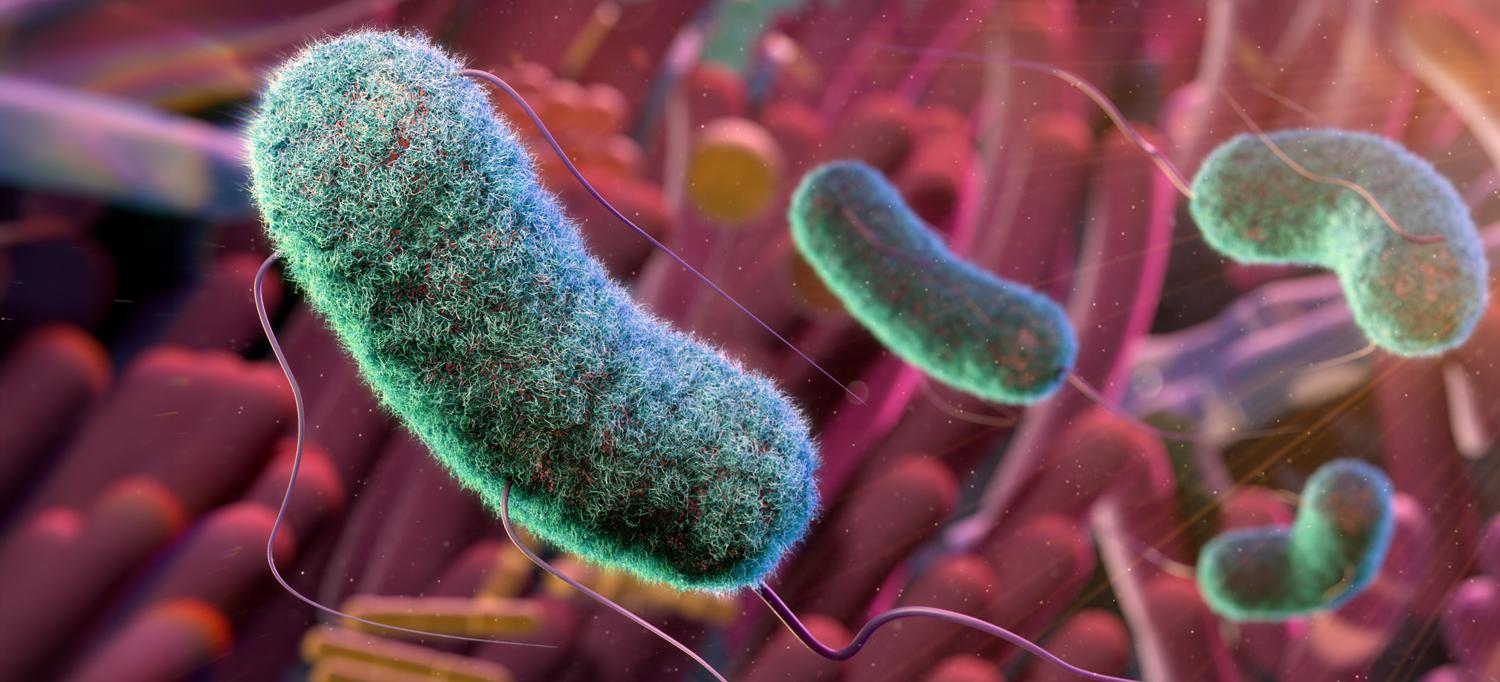
Predicting melanoma recurrence after surgery and immunotherapy has been difficult, but this study suggests that specific types of gut bacteria can serve as markers.
Credit: Getty / THOM LEACH / SCIENCE PHOTO LIBRARY
The specific mix of bacteria living in a person’s gut can predict the chances that melanoma will recur after surgery and immunotherapy, a treatment that helps immune cells target cancer cells. This is according to a new study led by researchers from NYU Langone Health and its Perlmutter Cancer Center.
Past studies showed that 25 to 40 percent of melanoma patients experience a recurrence despite these two standard approaches, but predicting which patients will see cancer return has been a challenge.
Publishing online April 17 in the journal Cell, the study of 674 patients enrolled in a global clinical trial revealed that differences in the amount of key bacterial groups (taxa) in the gut predicted cancer recurrence with up to 94 percent accuracy when patients were analyzed in a new way. The taxa associated most with changes in recurrence risk were Eubacterium, Ruminococcus, Firmicutes, and Clostridium.
“Our study identified for the first time gut bacterial types that can serve as markers of increased recurrence risk in these specific patients, which will help tailor treatment,” said study senior author Jiyoung Ahn, PhD, a professor in the Department of Population Health at NYU Grossman School of Medicine and associate director of population research at Perlmutter Cancer Center.
The gut microbiome is the community of trillions of bacteria that live in the human digestive tract. There, they train the immune system to recognize the difference between dangerous bacteria, which should be attacked, and bacteria that help digest food, which should be tolerated. Past studies have found that the study taxa interact with immune cells (such as natural killer cells and T cells) in ways that change a person’s response to immunotherapy. The bacteria may also affect the sugar supply that serves as fuel for cancer cell growth.
Geography Matters
The new study looked at the gut bacterial species from participants in an international clinical trial called CheckMate 915. Researchers analyzed bacteria in stool samples from people with melanoma who’d had their tumors surgically removed. Patients from five geographic regions (North America, Eastern Europe, Western Europe, Australia, and a sampling of other regions) then received either a combination of immunotherapies, nivolumab and ipilimumab, or nivolumab alone.
The research team discovered that the gut microbiome is a powerful predictor of melanoma recurrence—but with a twist. The bacterial markers that most accurately signal recurrence risk varied depending on where a patient lived.
By first grouping patients based on the overall similarity of their gut microbiomes regardless of where they lived, the research team found bacterial “fingerprints” that predict cancer recurrence in each region. Reading the sequence of DNA building blocks in all the bacterial species in patients’ guts, the researchers created a list of which species were present or not when melanoma recurred.
Using a standard measurement of microbial similarity, the team found that a signature derived from North American patients, for example, could accurately predict recurrence in patients from other parts of the world, but only if those patients had a similar bacterial fingerprint. Levels of these markers predicted cancer recurrence with 83 to 94 percent accuracy, depending on the geographic region.
“Past studies have struggled because the gut bacteria that predict treatment success seemed to change from one region to another,” said Dr. Ahn. “Our study provides a new method that overcomes this barrier, showing that these markers are indeed generalizable if we account for the person’s underlying microbiome.”
Finally, the research team found that the gut microbiome remained remarkably stable in patients during their yearlong course of immunotherapy.
“This means that a single pretreatment microbiome test could provide a reliable forecast of a patient's risk,” said study author Richard B. Hayes, DDS, PhD, MPH, a professor in the Department of Population Health. “The next step is to validate this matching approach in other cancers and to build the diverse databases needed to make this approach clinically feasible. In the future, we envision analyzing a patient’s microbiome before treatment, comparing it to a global database, and providing a reliable prognosis that guides therapy from the start.”
Along with Drs. Ahn and Hayes, study authors from NYU Langone were Mykhaylo Usyk, PhD; Huilin Li, PhD; Iman Osman, MD; and the late Jeffrey S. Weber, MD, PhD. Additional authors were Rob Knight, PhD, and Antonio González, PhD, of the Departments of Pediatrics, Computer Science and Engineering, and Bioengineering at the University of California, San Diego.
Funding for the study was provided by National Institutes of Health grants P50CA225450, P20CA252728, P30CA016087, R01CA159036, R01LM014085, U24ES036002, and U01CA250186.
About NYU Langone Health
NYU Langone Health is a fully integrated health system that consistently achieves the best patient outcomes through a rigorous focus on quality that has resulted in some of the lowest mortality rates in the nation. Vizient Inc. has ranked NYU Langone No. 1 out of 118 comprehensive academic medical centers across the nation for four years in a row, and U.S. News & World Report recently ranked four of its clinical specialties No. 1 in the nation. NYU Langone offers a comprehensive range of medical services with one high standard of care across seven inpatient locations, its Perlmutter Cancer Center, and more than 320 outpatient locations in the New York area and Florida. The system also includes two tuition-free medical schools, in Manhattan and on Long Island, and a vast research enterprise.
Media Inquiries
Greg Williams
Phone: 212-404-3500
Gregory.Williams@NYULangone.org