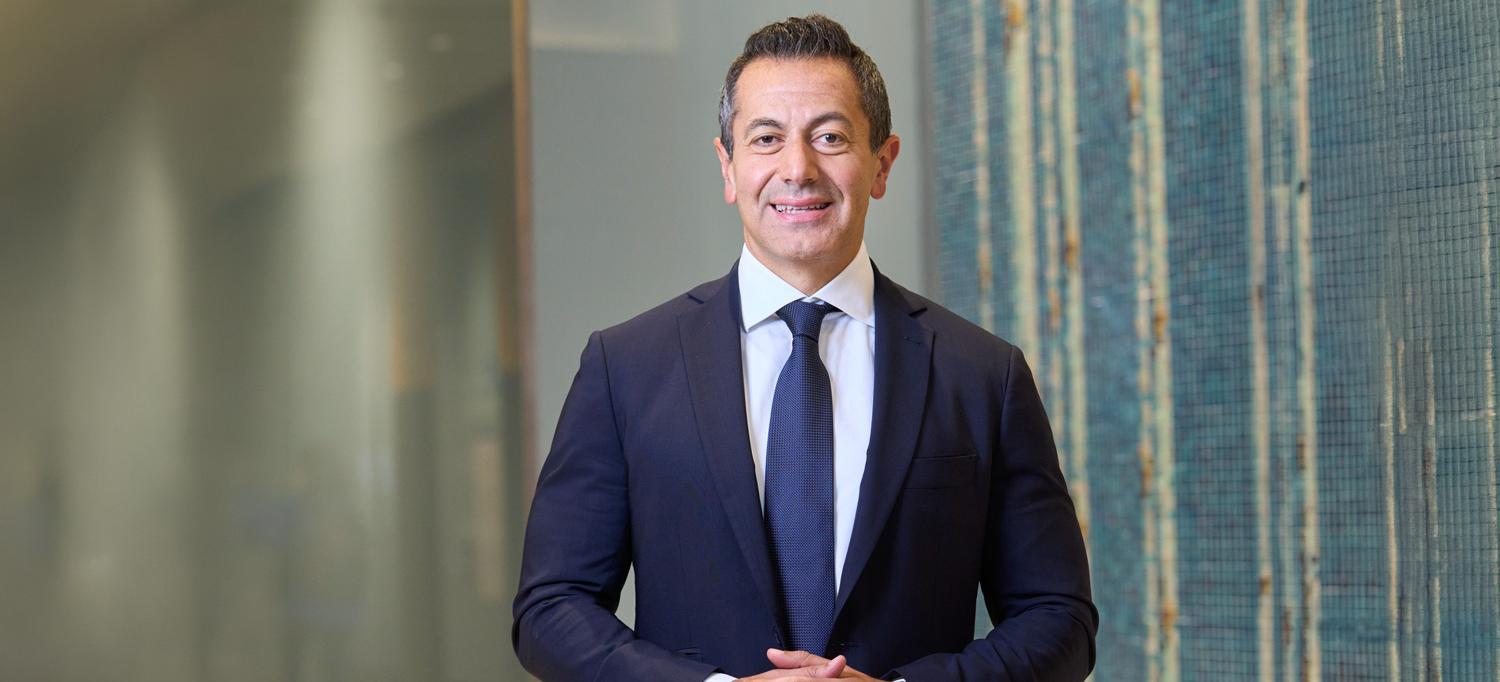
Dr. Oren Cahlon, NYU Langone Health’s executive vice president, vice dean for clinical affairs and strategy, and chief clinical officer
Credit: Juliana Thomas
During his two decades as a nationally recognized radiation oncologist, Oren Cahlon, MD, admired NYU Langone Health’s success—its rising rankings, growing clinical footprint, and research advances—from a distance. Then, after hearing former Dean and CEO Robert I. Grossman, MD, speak in person about the institution’s transformation, “I decided I wanted to be part of that winning team,” says Dr. Cahlon. He joined NYU Langone in 2022, and in September 2025 was named executive vice president, vice dean for clinical affairs and strategy, and chief clinical officer.
In his current role, Dr. Cahlon brings the same passion to expanding our network of ambulatory locations, establishing new service lines, and enhancing the patient experience as he does to treating patients with breast cancer. Here, he discusses NYU Langone’s ongoing commitment to serving patients where they live and work—not only in the five boroughs but also throughout Long Island, Westchester, Staten Island, Florida, and beyond—while always striving for improvement.
What’s been most surprising about the environment at NYU Langone?
Our culture of exceptionalism is truly on display every day. Although we have earned all these accolades—from U.S. News & World Report, Leapfrog, and Vizient, among others—there is no complacency. We’re extremely data oriented and measure everything. Our team looks at the dashboards constantly and is always striving to improve. We don’t hesitate to take on new challenges; we embrace them. And while we lead the nation in quality and safety metrics, our goal is even more ambitious: to continuously elevate the patient experience and clinical outcomes by learning from every interaction—and by expanding access to even more people and communities.
Why is it so important for NYU Langone to keep growing its footprint?
To some degree, we’re a victim of our own success. People know they will get the most innovative and exceptional care here, so the demand keeps growing. We also hear comments from patients like “The nearest office is 30 minutes from my house—can you open something closer?” People want quality and convenience. Having to take a day off work to travel into Manhattan for their medical care is not acceptable. Objectively, we know that if we get them into our health system, they’ll have better outcomes, so we need to extend our care to reach as many people as possible.
Most health systems funnel patients from satellites into their main campus. We have the opposite strategy: Deliver as much care as possible close to people’s homes. For example, even though we have a kidney transplant program in Manhattan, we are launching a kidney transplant program in Brooklyn as well, because the city’s largest borough deserves a world-class program to make it easier on the patient and their family. We’re doing the same thing with bone marrow transplantation, enabling patients on Long Island to get care nearby at Perlmutter Cancer Center, the only National Cancer Institute (NCI)–designated Comprehensive Cancer Center on Long Island, with access to clinical trials and subspecialization expertise. We’re building a bone marrow transplantation program in Brooklyn too. We’re big enough to take on such challenges, building complex, world-class services on multiple campuses—and we’re the only health system doing so.
Has our vision for growth and expansion changed under Dean and CEO Alec C. Kimmelman, MD, PhD?
Dean Kimmelman’s background as an investigator and clinician will enable us to prioritize undergoing scientific exploration and taking research from the bench to the bedside. Medical innovation and discovery are accelerating at a faster rate than ever, and they will become an even more important part of our strategy.
Of course, our driving force remains delivering the highest-quality care to our patients and being the primary health system where New Yorkers can receive healthcare close to home. The overwhelming majority of our patients receive their care in an ambulatory setting. We have more than 12 million outpatient visits annually, compared with approximately 150,000 admissions to our hospitals. Our strategy has been to care for patients while they are well and try to prevent patients from needing to go to the hospital. We grow our patient base by developing physician practices, screening programs, and radiology programs, and by focusing on preventive medicine, primary care, and subspecialty medicine. We think having a lot of ambulatory practices—while investing deeply in our few hospitals to ensure they are world-class, as we’ve done in Brooklyn, Nassau, and Suffolk—is an efficient model.
What clinical areas or service lines are the main focus of our growth goals?
We want to provide patients with all their care from birth till death and everything in between. There are almost no services we don’t offer within our health system, and our plan is to add even more. Fetal surgery is an example. There was no fetal surgery center in New York City, forcing families to travel to specialized children’s hospitals. It’s a complicated, resource-intensive service line that requires a lot of multidisciplinary care. Last year, we committed to developing a fetal surgery center, and patients from the region can now receive their care here; we are attracting patients from around the country.
The NYU Langone Transplant Institute is one of the leading programs in the world and a pioneer in transplant research, including xenotransplantation, the use of genetically modified animal organs in humans to address the organ donor shortage. We have also become a destination center for complex cardiac care, lung disease, neurology, and neurosurgery, all specialties ranked No. 1 by U.S. News & World Report. Keep in mind that many of these patients also need endocrinology care, imaging, and primary care, so we must grow those areas as well. The beauty of an integrated health system, with all the doctors working together, is that it’s seamless and coordinated at all of our seven inpatient facilities and 330-plus outpatient locations.
Anirban Maitra, MD, was recently appointed director of Perlmutter Cancer Center by Dean Kimmelman. Do you think their familiarity with each other will enhance our efforts to build a top 5 cancer center?
Absolutely. Perlmutter Cancer Center has been an NCI-designated Comprehensive Cancer Center for over a decade, and having Dr. Maitra in charge will further accelerate its rise. He is a world-renowned pathologist, scientist, and collaborator, and we’re very lucky to have him. Dr. John Leonard, one of the world’s foremost leaders in lymphoma and hematologic malignancies, joined us last year as chief clinical officer for enterprise cancer strategy and operations. He has been integral to our recent growth and is a critical part of our future success. Our research and ability to fight and cure cancer are rapidly evolving and extremely exciting. We are at the forefront of this innovation and opportunity.
What is the biggest challenge in scaling the network while maintaining the same level of quality?
Delivering on our promise of one system, one standard. We need to ensure that every single patient, no matter which location they’re seen in, receives the same level of professionalism, quality, safety, and standardization. We have the infrastructure to achieve that because we’re all on Epic, our electronic health record system. We know what happens at every location in our network. We can see how long a patient waited or whether they got their follow-up visits scheduled right afterward. While assessing quality outcomes has historically been more challenging in the ambulatory network, we are working in each specialty, across every location, to develop the data and dashboards to measure them.
Of course, recruiting physicians of the highest quality and integrity is critical to our expansion plan. So for the 750 faculty we add each year, we’ve implemented a rigorous vetting process to ensure that everyone we hire is aligned with our culture of exceptionalism and empathy. Clinical expertise alone is not enough. Our patients need to know we care about them as individuals. Empathy deepens the connection, builds trust, strengthens healing, decreases anxiety, and is linked to better outcomes as well as greater patient satisfaction—and it is woven into daily life across our institution.
How is AI impacting our clinical care?
The power of AI for predictive analytics within preventive medicine is enormous. Rather than waiting for an adverse event to happen, we can now use existing data to identify and predict which patients are at greatest risk for cardiac events, neurological events, and cancer, among others, and intervene earlier than ever before to prevent these potentially life-threatening events from occurring. We are also using AI to implement reminders on Epic for doctors: Have you ordered this test? Have you thought about that diagnosis? AI scans a patient’s medical record and ensures we’re standardizing the process and not missing anything. The technology is enhancing efficiency too. Approximately 1,500 of our doctors now use Ambient AI to transcribe the entire interaction with a patient, allowing us to go back to why most of us became doctors: to have the human interaction. We piloted the technology for a year and then rolled it out large-scale, and doctors say it is life-changing for them. Not only is it a huge time-saver, but because clinicians don’t need to worry about taking notes, their attention is undivided. Over time, we think this technology will reduce physician burnout while improving patient satisfaction and efficiency.
You’ve had a distinguished career as a radiation oncologist. In fact, you still treat patients. How do you find the time?
I still love seeing patients—it’s why I went into medicine, and I don’t plan on giving up that part of the job. I also think my hands-on clinical work is helpful in understanding our practices, how Epic and MyChart messaging work, the role of the nurse practitioner or physician assistant, and the process of ordering tests. When a new policy is put in place, it’s easier to gauge its impact. If you’re going to lead 5,000 doctors and run a faculty group practice network, it’s valuable to have that hands-on experience.
The New York healthcare market is highly competitive, yet NYU Langone growth has shown no signs of slowing down. How do we keep it going?
You’re only as good as your last patient outcome, your last encounter. We have become the place where New Yorkers want to receive their healthcare, and that’s a big market. There are millions of patients out there who want to come to us for their care. And if we make it easy, accessible, and patient friendly and maintain the highest quality, we’ll keep on growing. The demand for our care is seemingly endless, and we will continue to do everything we can to meet the demand. There’s no slowing down in sight.