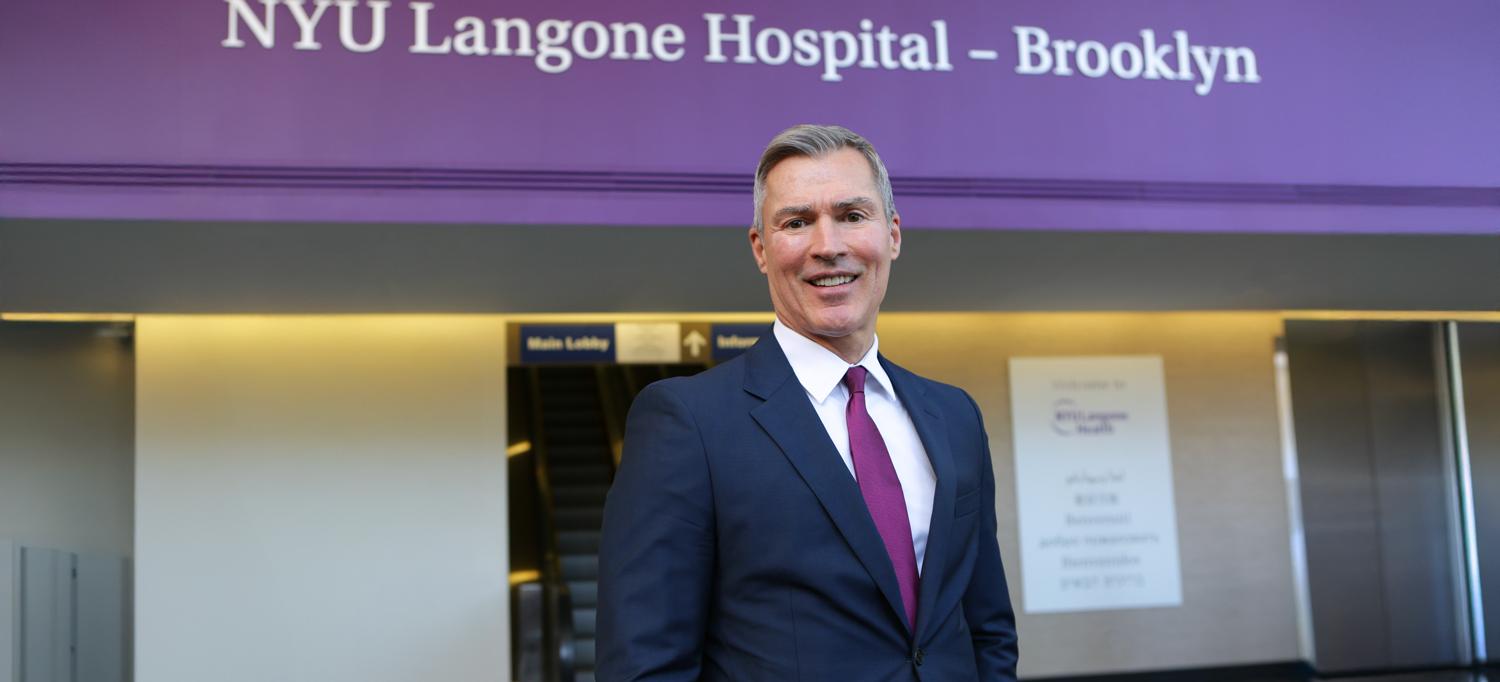
“It’s all been about bringing quality care closer to home,” says
Executive Vice President and Chief of Hospital Operations Bret J. Rudy, MD. “The more we can do here, from initial visits to treatments to follow-ups, the easier it is for patients.”
Credit: John Abbott
Executive Vice President and Chief of Hospital Operations Bret J. Rudy, MD, faced a daunting task when he took the helm at NYU Langone Hospital—Brooklyn in 2016: how to integrate the former Lutheran Medical Center, a safety net hospital on the verge of closing in a community with the highest concentration of Medicaid recipients in the country, into NYU Langone Health’s culture of excellence.
“No one thought we could come in and have the same success that we had in Manhattan,” says Dr. Rudy. “But we were determined to bring the same high standard of care to southwest Brooklyn that patients receive throughout our health system.”
A decade later, the achievement of that mission is a resounding success. NYU Langone Hospital—Brooklyn, a 450-bed acute care teaching hospital, with an acclaimed comprehensive stroke center and a Level 1 Trauma Center, is now among the safest hospitals not just in New York City, but also in the United States as a whole. Its key metrics—mortality rate, average length of stay, readmission rate—have all improved dramatically. NYU Langone has invested heavily to recruit top clinicians, install cutting-edge technologies, and expand services, most notably cardiac and cancer care. The hospital, located in Sunset Park, now supports a growing number of clinical trials and research initiatives that cater to and recruit from the local community. The nursing staff has achieved Magnet® designation, the gold standard for nursing care in the United States. What’s more, the hospital’s reputation has soared. In the last year alone, its ranking by Vizient Inc., a leading healthcare performance organization, jumped from No. 13 to No. 6 nationwide within the large specialized complex medical cohort.
Dr. Rudy is not resting on this growing list of laurels. “We are continually improving our facilities and technology to provide our patients with the most advanced healthcare in a comfortable environment,” he says. “Every change we make is focused on providing better care, tearing down the walls that reduce flexibility and collaboration, and healing our community.” Here, he discusses NYU Langone Hospital—Brooklyn’s dynamic transformation and the path to continued excellence and improvement.
What was your vision when you assumed leadership of the hospital, and how has it evolved over time?
Our overall goal was to improve the level of patient care across the board. [Former Dean and CEO] Robert I. Grossman, MD, and [former Board Chair] Kenneth G. Langone were committed to Brooklyn from the beginning, and [current Dean and CEO] Alec C. Kimmelman, MD, PhD, and [Board Chair] Fiona Druckenmiller have picked up that mantle.
We brought in physicians who were better aligned with NYU Langone’s approach to safe, high-quality care. Then we studied the neighborhoods and populations we serve to better meet the needs of the community. For example, with our cancer program, we opened Perlmutter Cancer Center—Sunset Park, but then we realized we’ve got to do more. So we developed a comprehensive, integrated cancer program with disease-specific groups that take care of patients in collaboration. Through philanthropy, we’ve been able to provide resources for patient navigation, and that has helped patients enrolled in research trials. It’s a similar story with cardiac care. We had a good program, but we needed to expand our services to include heart failure, electrophysiology, and cardiac surgery so we could take care of more patients here in Brooklyn. It’s all been about bringing quality care closer to home. The more we can do here, from initial visits to treatments to follow-ups, the easier it is for patients. The commute to Manhattan can be burdensome. Not only are these patients ill, but their families must travel too.
What defines the culture of the hospital today?
Our staff is incredibly dedicated and engaged. Many of them come from the communities we serve and speak the same languages as our patients. People who have been here a long time appreciate the resources we’ve brought to the community. You need technologies to support advanced care, so we’ve added robotic surgery to every applicable service line. Patients who would’ve been in the hospital for three to five days now go home the same day or the next day, with a shorter recovery time and less pain. That makes a difference, because many of our patients don’t get paid if they can’t work.
Another defining characteristic is enhanced collaboration. NYU Langone Heart, which integrates a constellation of clinical services across the institution’s 7 inpatient locations and more than 70 adult cardiology and cardiac surgery practices, and Perlmutter Cancer Center, an NCI-designated Comprehensive Cancer Center, are great examples of how to bring experts together to build a program, train clinicians, and ensure there’s connectivity to our ambulatory care system. Without NYU Langone Heart’s co-directors, Dr. Larry A. Chinitz and Dr. Mathew R. Williams, we wouldn’t have been able to establish a cardiac surgery program. That, in turn, has allowed us to add more procedures to the cardiac catheterization lab. Our strength lies in our integration with a world-class academic health system.
How has Epic, our electronic medical record, improved clinical operations?
When we took over, some areas of the hospital were entirely on paper. Some parts were on one electronic medical record, and others were on an entirely different system. If you were treated in our emergency department and went to see your primary care provider the next day, they could not see what care you had received. When the hospital went live with Epic, it was like, Wow! We now have access to all the data instantly, which improves our clinical care and enables us to better coordinate with our ambulatory network. Nader Mherabi, executive vice president and vice dean, chief digital and information officer, leads the best health system IT enterprise in the country. The way we’re able to utilize the data to continue to innovate care in Brooklyn is just amazing.
What are the most significant advances you’ve seen in terms of patient care and clinical outcomes?
The reduction in observed to expected mortality rates—a measure comparing the actual number of deaths that occurred in a specific group to the number of deaths that were predicted based on factors like age, sex, and the severity of illness—has been remarkable. When we started, we had 20 percent higher mortality rates than comparable hospitals. Now, we have among the lowest mortality and infection rates anywhere. We’ve also decreased our average discharge time by 23 percent. Getting patients through the hospital has allowed us to increase volume, and it reduces hospital costs for patients. Readmissions are down significantly, too, in part because we’ve improved the handoff of patients into the community.
Is there a specific change that’s had a meaningful impact on patient quality or satisfaction?
I’d point to the Emergency Department (ED), the point of entry for many patients. The ED sees hundreds of patients a day, and it’s a challenging environment. You’re dealing with people from varied backgrounds who are dealing with such a variety of illnesses, injuries, and ailments. We changed much of the ED staffing to improve the quality and safety. We brought in new leaders who were aligned with the hospital. They’re highly skilled, are good at recruiting faculty, have a very strong residency training program, and work collaboratively with all the other services. If you get good care at the very beginning, it leads to great care during hospitalization. We also plan to double the size of our ED, creating a better environment for patients, with more privacy.
Do you have a favorite anecdote about a grateful patient that epitomizes the improved overall care?
People expect our doctors to be great, and they are. But what they comment on most often is how we make them feel, that we show empathy and speak to them respectfully. They may tell us the surgery went smoothly, but then they’ll mention a nurse by name who stood out to them. Or maybe a kind transporter who took them to a CT scan and made them feel better. It’s those brief touches that are 90 percent of what our patients end up talking about. The fact that our staff shows that they care is where I’ve seen the biggest impact on the community.
Sunset Park has a high percentage of foreign-born residents. How has the hospital worked to make healthcare more accessible for these residents?
When you’re working with many different ethnicities, you need to meet patients where they are and tailor your care to meet their needs. One critical component has been the Voyce translation system implemented by our Medical Center Information Technology Department. It connects patients, their families, and clinicians with a live video interpreter and covers more than 240 languages and dialects. The service’s speed, efficiency, and accuracy improve communication and enhance safety, which leads to better outcomes.
Why is the ambulatory surgery center, currently being built across the street and scheduled to open in late 2026, big news for the hospital?
Because it will enable us to transfer lower acuity outpatient procedures from our current operating rooms (ORs) to the new facility. This will reduce delays in the ORs and improve the patient experience while allowing us to expand our services. Perlmutter Cancer Center is growing so rapidly that it’s going to occupy a floor in the new building, much of it dedicated to breast cancer care. Women can get diagnosis, treatment, and surgery in the same building. We’ll also move endoscopy services there and have doctor’s offices for critical partners, including Faculty Group Practices and Family Health Centers. No matter how good the care in the hospital may be, offering high-quality primary and specialty care is just as critical to health in the community. The Family Health Centers provide great primary and preventive outpatient care and mental health services, while the Faculty Group Practices are vital for providing a range of specialists accessible to our community.
Are other major service line expansions in the works?
We’ve recently started performing transcatheter aortic valve replacements, a minimally invasive alternative to open heart surgery. Kidney transplants are scheduled to begin early this year. We will expand into bone marrow transplants and CAR T cell therapy, critical second-line treatments for a lot of different cancers, headed by Dr. Oscar B. Lahoud, a national expert in the field and our new chief medical officer. Finally, we plan to keep growing our clinical trials portfolio. We view it as a prime way to improve care.
What are your strategic priorities—and opportunities—for the next five years?
Number one is to continue setting the standard for care—performing noninvasive and less-invasive surgeries that get patients in and out faster. These are better for patients and better for the hospital. We need to keep pursuing the most current therapies for heart failure, cancer care, and other areas. We’re embarking on programs with colleagues in our ambulatory care network to better monitor patients, feed that data back to primary and specialty care physicians, and use navigators to help patients with medical and social needs—in short, to create a seamless continuous-care model. Finally, as Dr. Kimmelman points out, we need to embrace the fully integrated nature of our health system and break down the barriers between education, research, and clinical care. We have so much information we can take in from our patients, and it will help inform the future of healthcare. Being nimble that way will be a game changer for us.