Our neuroscientists are harnessing neuroplasticity—the brain’s capacity to reorganize in response to new experiences—to help people interpret sound more quickly and effectively.
Cochlear implants have transformed what is possible for people with profound hearing loss. But the next major advance may depend less on the device itself than on the brain's ability to learn how to use it.
In the latest episode of NYU Langone Health's Behind the Breakthrough video series, neuroscientists Robert C. Froemke, PhD, and Ariel E. Hight, PhD, and cochlear implant surgeon J. Thomas Roland Jr., MD, discuss how they are harnessing neuroplasticity—the brain's capacity to reorganize in response to new experiences—to help people interpret sound more quickly and effectively.
Their work addresses one of the field's most persistent challenges. A cochlear implant delivers signals to the auditory system, but the brain must still learn to translate them into recognizable speech and sound. Some patients adapt relatively quickly; for others, the process can take months or years.
For Dr. Hight, that question is both scientific and personal. Born deaf, he received his first cochlear implant at age 3. The device gave him access to sound, but learning to interpret it was gradual.
"It was a remarkable achievement to be able to go from completely deaf to hearing, but it took a few years," said Dr. Hight, a postdoctoral fellow in the Froemke Lab at NYU Grossman School of Medicine.
Watch the newest episode of Behind the Breakthrough showing how Robert C. Froemke, PhD, Ariel Hight, PhD, and J. Thomas Roland Jr., MD, are harnessing neuroplasticity—the brain’s capacity to reorganize in response to new experiences—to help people interpret sound more quickly and effectively.
When he received a second implant at age 25, Dr. Hight experienced the process more consciously, hearing initially disordered sounds become increasingly refined. That experience now informs his research into why patients adapt differently and how the process might be improved.
"In a way, it's like the brain is trying to learn a whole new language that's muffled and difficult to understand," said Dr. Froemke, professor in the Department of Otolaryngology—Head and Neck Surgery and the Skirball Professor of Genetics in the Department of Neuroscience at NYU Grossman.
The focus of the team's latest research is the locus coeruleus, a small region deep in the brainstem that helps regulate alertness, attention, and the brain's readiness to learn. "It's the brain's alarm clock," said Dr. Froemke. "It helps us become alert—almost like a jolt of caffeine waking us up in the morning."
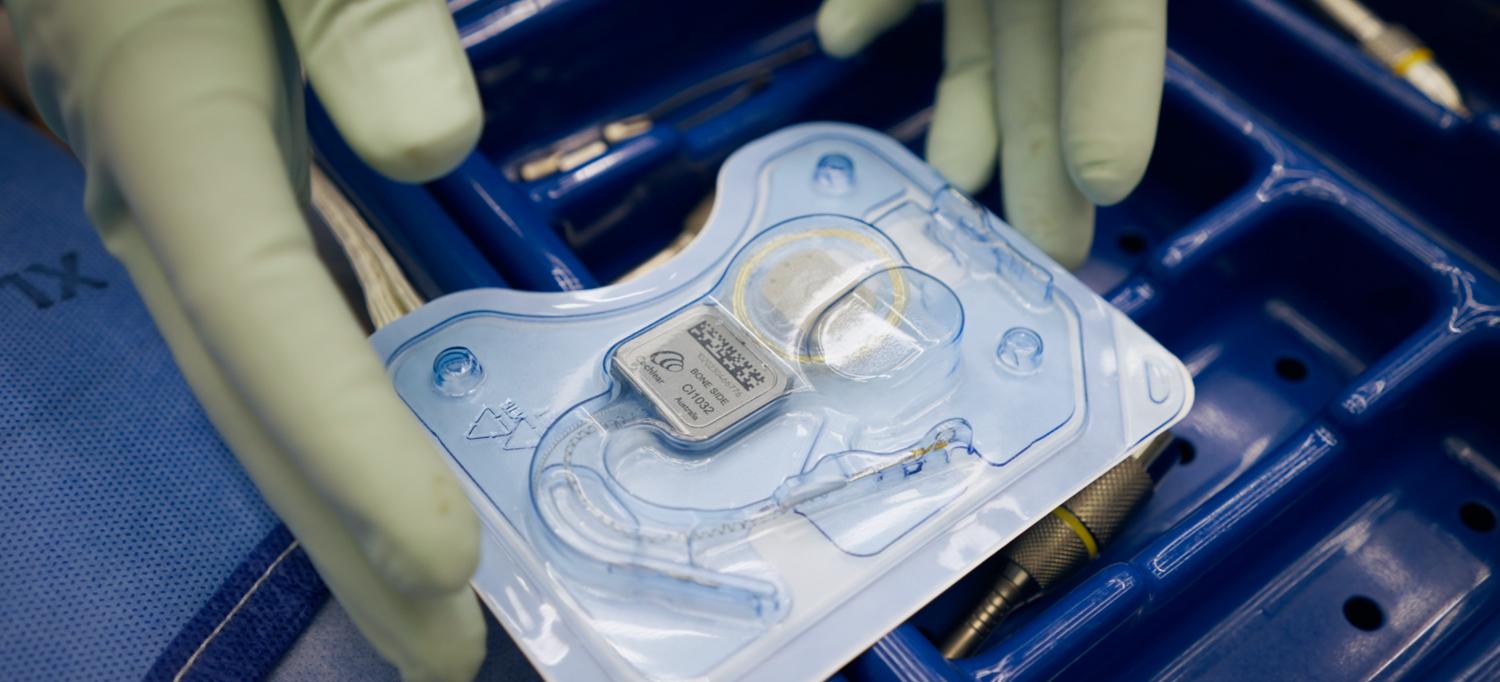
The team has shown in animal studies that stimulating a branch of the vagus nerve—the largest cranial nerve in the body—activated the locus coeruleus and made the brain more receptive to unfamiliar sounds. That finding has now led to a clinical test at NYU Langone's Cochlear Implant Center of a modified cochlear implant that repurposes an existing electrode to stimulate the vagus nerve.
Dr. Roland, a renowned ear surgeon at the Cochlear Implant Center, has implanted four patients with the device so far. After confirming that the modification does not interfere with the implant's standard function, researchers plan to compare performance on difficult listening tasks with and without stimulation. The goal is to determine whether that added stimulation can accelerate the brain's adaptation to sound—and ultimately help patients communicate more easily, appreciate music, participate in conversations, and connect more fully with friends and family.
This work is possible because of NYU Langone's unusually close integration of patient care and scientific research. The Cochlear Implant Center has grown into one of the largest clinical and research-focused programs of its kind, bringing together surgeons, specialized audiologists, neuroscientists, postdoctoral fellows, and laboratory staff.
"Very few places have this magnitude of researchers working across basic science, clinical translation, surgery, device design, and signal processing," said Dr. Roland, professor in the Department of Otolaryngology—Head and Neck Surgery and in the Department of Neurosurgery at NYU Grossman. "We're unique in the breadth of our expertise, and we've come up with game changers to help people hear even better."
That breadth allows a question first observed in patients—why some people adapt to cochlear implants more readily than others—to move into the laboratory, and then back toward the clinic as a potential new treatment. It's a continuous exchange between discovery and care, with the patient experience serving as both the starting point and the measure of success.
"At some point," Dr. Froemke said, "everything that we're doing in the lab has to have some kind of connection to the human experience."